Europe has money. It needs factories.
A Munich startup is about to begin building three thousand interceptor drones a month, having raised roughly forty-six million euros…
The gap between what frontier AI earns and what is being spent to make it possible is enormous, and it is usually reported using the most flattering measure available. Read it with the right numbers and the interesting question is no longer whether AI is a bubble. It is that one lab has just shown the revenue can arrive, and that the structures built while everyone waited for it will outlast the waiting.
Enable JavaScript and use a browser with spoken audio support to listen.
Read aloud by your browser. Voice and availability depend on your device.
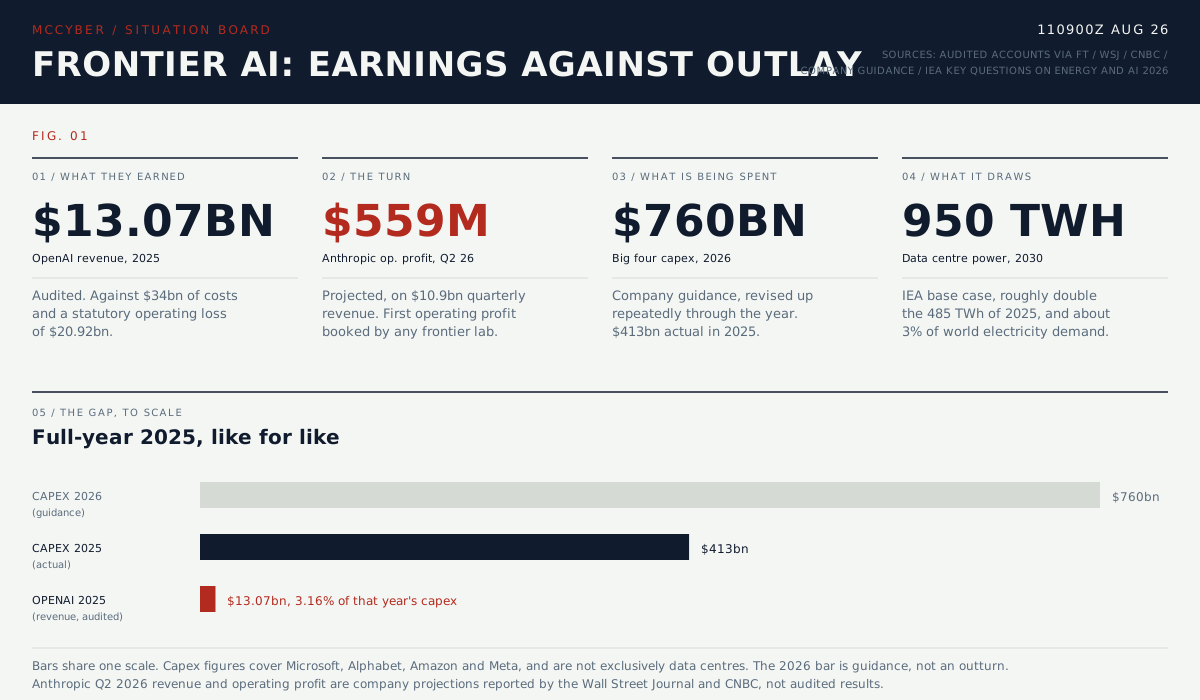
The International Energy Agency’s 2026 report Key Questions on Energy and AI records that the capital expenditure of five technology companies now exceeds global investment in oil and natural gas production. Those companies spent over $400bn in 2025 and are expected to spend around 75% more this year. Much of that increase, though not all, is data centres.
The companies building the models that justify the spending are a great deal smaller. OpenAI booked $13.07bn of revenue in 2025. Anthropic booked $4.8bn in the first quarter of 2026. Both are growing at rates with few precedents, yet the distance between the two sets of numbers is the whole subject.
Four numbers are needed to see it clearly: what the labs earned, what they say they are earning now, what they expect to earn, and what everyone else is spending. Most coverage blends the first two.
Run-rate revenue annualises a single month’s sales, which flatters any company growing quickly, as an earlier essay set out. Only booked revenue tells you what was actually sold in a period.
OpenAI’s position is unusually well documented, because in June audited financial statements obtained by the writer Ed Zitron and independently verified by the Financial Times replaced years of estimate. Revenue was $13.07bn in 2025, roughly triple the $3.7bn of 2024. Costs were $34bn, including $19.18bn on research and development, a line that on its own exceeded the entire top line. The statutory operating loss was $20.92bn.
Which loss you quote turns out to matter. The widely reported $38.5bn net loss is inflated by a one-off non-cash charge from the conversion out of non-profit status. A person familiar with the accounts told the FT that stripping that charge, along with stock compensation and computing credits from Microsoft, leaves an underlying cash burn closer to $8bn, which is a company-friendly measure from an anonymous source rather than a line in the accounts. The statutory $21bn has been audited; the $8bn describes cash actually leaving the building. Both are real, and an essay about choosing the right measure should say so.
One figure cuts against the general gloom. In 2024 OpenAI spent $2.37 to generate each dollar of revenue; in 2025 it spent $1.60. The losses grew while the unit economics improved.
Anthropic’s run-rate has been reported endlessly. The booked figures matter more and have had less attention. CNBC and the Wall Street Journal reported quarterly revenue of $4.8bn in Q1 2026 and a projected $10.9bn in Q2, alongside a projected operating profit of $559m. As recently as last summer the company was telling investors that full-year profitability was unlikely before 2028. Compute costs fell from 71 cents per revenue dollar to 56 cents in a single quarter, which is what moved it.
That single quarter is the most consequential financial event in the sector this year, because it establishes that a frontier lab can cover its costs. Whether it can do so while continuing to train frontier models is a different question, and training expenditure is what makes the annual picture harder than the quarterly one.
Two labs dominate the discussion because two labs have to raise money in public. The others do not.
Google DeepMind builds Gemini inside Alphabet, funded from search advertising, and Alphabet publishes no separate revenue line for it. Outside estimates circulate, none of them checkable against a disclosure. Meta’s superintelligence effort is funded entirely from advertising profits and discloses nothing separately either. Microsoft develops in-house models alongside its OpenAI stake. xAI was absorbed into SpaceX, whose prospectus disclosed an operating loss of $6.4bn for its AI segment in 2025, which is the only audited figure any of these four has produced.
The pattern is worth naming. The labs whose finances are visible are the ones dependent on external capital. The labs inside profitable parent companies can lose money indefinitely without anyone being able to measure it. Absence from the league table reflects a stronger position rather than a weaker one. Chinese and European labs operate under different constraints again, and deserve their own treatment.
The two visible labs are also less independent than the framing suggests. Microsoft holds roughly 27% of OpenAI on an as-converted basis, a position valued at about $135bn at the October 2025 restructuring, against some $13bn invested since 2019. OpenAI paid Microsoft $17.2bn in 2025 for cloud and research services, so a substantial share of what OpenAI books as cost returns to its largest shareholder as revenue. Amazon is Anthropic’s largest outside investor, Google holds a stake capped at 15% with no voting rights, and in November 2025 Nvidia committed up to $10bn and Microsoft up to $5bn alongside an Anthropic commitment to buy $30bn of Microsoft cloud capacity. In February 2026 Amazon committed up to $50bn to OpenAI while remaining Anthropic’s biggest backer.
The effect of these holdings has now become visible in ordinary corporate accounts, and the numbers are startling. CNBC reported this month that stakes in the labs are distorting Big Tech’s reported earnings: Amazon booked a $53.4bn gain primarily from its Anthropic investment, turning underlying earnings growth of roughly 17% into a headline figure above 240%. Alphabet’s bottom line grew nearly 300% where the underlying business grew about 23%.
This is the circularity that critics point to, and describing it accurately matters more than deciding whether it is sinister. Suppliers finance customers, customers commit to suppliers, and the resulting valuation gains flow back into the suppliers’ reported profits. Some of that is a normal response to scarce capacity and long lead times. Some of it makes demand look more independent than it is.
Subscribe
New essays and snapshots, by email, roughly weekly.
Microsoft, Alphabet, Amazon and Meta are on course for something close to $760bn of combined capital expenditure in 2026, against $413bn in 2025, after repeated upward revisions through the year. Alphabet’s July increase was received badly enough to pull the sector down with it, which is the first serious sign of investors asking about return on capital rather than scale.
Electricity increasingly determines where any of this can be built. The IEA’s 2026 projection has data centre consumption roughly doubling from 485 TWh in 2025 to 950 TWh in 2030, reaching about 3% of global electricity demand, with AI-focused facilities tripling over the period.
Water is disclosed patchily and the metrics are not comparable between companies. Google’s 2026 Environmental Report records 10.9bn gallons consumed in 2025, up 34%, against 7.7bn gallons replenished, roughly 78% of its freshwater consumption. The same report discloses a 37% rise in electricity demand alongside a 2% cut in operational emissions, which fairly summarises the industry: efficiency improving, absolute consumption climbing anyway. Withdrawal and consumption are different measures, and comparing companies without checking which is quoted produces nonsense.
Whether the buildout pays for itself is a separate question from whether either lab does. J.P. Morgan calculated that it requires roughly $650bn of new annual revenue in perpetuity to return 10%. Bain put the 2030 requirement at $2tn of annual revenue, with an $800bn shortfall.
As both labs raised enormous sums through the year, detailed internal forecasts began circulating among investors. Documents reported by the Wall Street Journal show OpenAI projecting revenue approaching $275bn by 2030, with about $121bn spent on training compute in 2028 alone and operating losses peaking near $85bn that year. It does not expect positive free cash flow before 2029 or 2030. Anthropic expects to approach $150bn by 2029, with training costs peaking near $30bn.
None of that is guaranteed. Price competition, slower enterprise adoption or regulatory intervention could each materially change the numbers, and forecasts supplied by companies raising money should be read accordingly.
The bear case has a weak joint. Almost all of the infrastructure spending is being done by four companies that remain enormously profitable and are funding it substantially from operating cash flow. This is not the telecoms buildout, where the construction was done by leveraged entities with no other business. J.P. Morgan’s private bank noted on 5 August that second-quarter cloud revenue grew 48% year on year across the top three providers, with backlogs near $1.7tn, and the bank raised its S&P 500 target last week citing the return-on-capital question easing. The institution that produced the $650bn figure has moved, which is worth stating plainly.
The AI labs can lose fortunes while the buildout still makes sense for Microsoft, Amazon, Alphabet or Meta. Those are different bets with different balance sheets behind them.
The fragility sits in less dramatic places. Depreciation assumptions set in 2023 about how long AI servers stay useful are being revised, and Amazon shortened its server life from six years to five in 2025, citing the pace of technological development. Every year removed from an asset’s assumed life raises the annual charge against reported profit. It is an accounting question rather than a demand question, and therefore easier to miss until the charges start flowing through the income statement. The hyperscalers also expect to issue $150bn to $200bn of debt this year, which is where a slower revenue ramp would first hurt.
The revenue gap does not predict a crash. It sorts the industry by who can afford to wait.
OpenAI and Anthropic need capital, and must keep raising it on terms set partly by the companies that own the infrastructure they rent. Microsoft, Amazon, Alphabet and Meta own cash-generating businesses and can subsidise a transition for years without asking anyone’s permission. That much has been clear for a while, and this publication has described the financial machinery built around it: guarantees, leases and vendor finance assembled because a lab with extraordinary revenues still cannot borrow on its own name against fifteen-year assets.
What that machinery assumed, and could not yet demonstrate, was that the tenant would eventually generate enough cash to pay the rent. A quarter of $10.9bn with $559m of operating profit is the first evidence on that question, and it points the right way. It is one projected quarter rather than an audited year, it excludes the training runs that make the annual picture harder, and a single data point is not a trend. But the case for treating compute as infrastructure rather than as a bet on model quality now has something underneath it beyond the strength of the guarantor.
That is the more uncomfortable finding. The bear case has spent two years arguing that the revenue will never arrive. If it does arrive, the structures built during the waiting period do not unwind. The guarantees, the equity stakes taken in exchange for them, the leases and the power contracts all remain, and they were written when the labs had no leverage. Success on the revenue question resolves the smaller argument about whether this was a bubble, and confirms the larger one about who ends up holding the industry.
Sources: International Energy Agency, Google 2026 Environmental Report, Financial Times, Wall Street Journal, CNBC, Fortune, Fast Company, Bain & Company, J.P. Morgan, Statista, Ed Zitron.
Subscribe
McCyber intelligence briefings and structural essays, directly. No institutional spin.