Who can afford to lose money on AI
The gap between what frontier AI earns and what is being spent to make it possible is enormous, and it is usually reported using the most…
Alphabet has written $43.8 billion of backstops on data centres it does not own, against which it carries a fair-value liability of $815 million. Nvidia has just answered with $500 billion of financing platforms of its own. The AI contest is still reported as a race between models and chips. The more consequential competition is now over who can supply the cheapest credit, and where the risk settles once the arranging is finished.
Enable JavaScript and use a browser with spoken audio support to listen.
Read aloud by your browser. Voice and availability depend on your device.
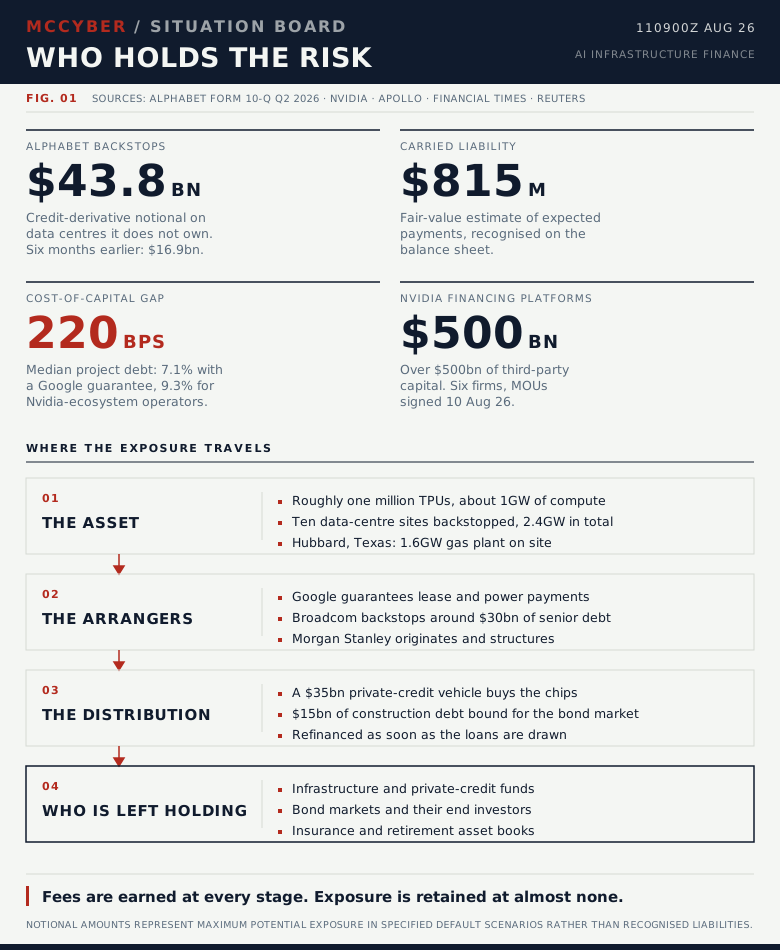
Alphabet’s most recent quarterly filing discloses credit derivatives with a gross notional value of $43.8 billion. These are backstops on payment obligations at data centres the company does not own. Six months earlier the same line read $16.9 billion. The fair-value liability Alphabet carries against them is $815 million.
The two figures measure different things, and both are properly disclosed. The notional amount is what the filing calls the maximum potential exposure in specified default scenarios, on agreements running up to fifteen years. The $815 million is Alphabet’s probability-weighted estimate of what it expects actually to pay, arrived at using inputs the filing lists as counterparty risk, credit default rates and its own contractual rights. Nothing here is concealed.
The distance between the two numbers is nonetheless a fair summary of how the artificial intelligence build-out is being paid for. Obligations of enormous size, arranged so that no single set of accounts displays the scale of the undertaking. The same filing records a $20 billion commitment of future capital funding to an unnamed private company, contingent on operational and financial milestones through 2030, which Alphabet accounts for as an equity derivative. Even the equity has a notional value now.
On Monday, Nvidia announced partnerships with Apollo, BlackRock, Blackstone, Brookfield, Goldman Sachs and KKR to mobilise over $500 billion of third-party capital for AI infrastructure. Read as a fundraising story, the number is merely large. Read as a competitive response to what Google has spent the past year building, it is the most revealing thing Nvidia has done all year.
Anthropic can plainly raise money. It closed a $65 billion round in May, and the structures described below exist precisely because capital is available to finance infrastructure built for it. What it cannot do is borrow on its own name against fifteen-year assets at anything close to Alphabet’s cost of capital. It carries no rating from the major agencies, and at this scale it has a revenue record measured in months.
Those revenues are extraordinary. Anthropic disclosed run-rate revenue of $47 billion in May, up from roughly $9 billion at the end of 2025. Run-rate annualises a single month, which flatters any company whose growth is about to slow, so the figure describes momentum rather than an established earnings base. A lender writing paper that matures in 2041 needs the second thing.
Google’s answer was to lend Anthropic its own creditworthiness instead. The resulting structure runs to roughly $200 billion of interlocking contracts, with about four-fifths tied to the chips. In June, a vehicle led by Apollo alongside Blackstone and a group of banks provided a $35 billion capital solution that bought roughly a million tensor processing units, about a gigawatt of compute, and leased them to Anthropic. Morgan Stanley arranged it. Broadcom, which co-designs the chips, guarantees around $30 billion of the senior debt if Anthropic stops paying and the hardware cannot be resold for enough to cover it.
Housing the chips required a second structure. Google turned to former cryptocurrency miners holding spare grid connections, guaranteeing lease payments at sites operated by TeraWulf, Cipher and Hut 8, and has now backstopped ten developments carrying 2.4 gigawatts. The largest is a 2,000-acre campus at Hubbard, Texas, developed by Nexus Data Centers with a 1.6 gigawatt gas plant on site. A bank group led by Morgan Stanley has arranged roughly $15 billion of construction debt for it. Google guarantees Anthropic’s lease and power obligations in return for about a fifth of the equity. The banks intend to refinance into the bond market as soon as the loans are drawn.
Everyone involved reaches for the same comparison: this is vendor finance, the model Boeing and GE built to sell aircraft and engines. The comparison holds, up to a point. Jet engines had four decades of resale history behind them before anyone lent against their residual value.
The most important consequence of all this is a price. According to the Financial Times, data centre projects carrying a Google guarantee borrow at a median 7.1 per cent. Projects built around Nvidia chips without one borrow at 9.3 per cent. Jefferies analysts describe the gap as a structural cost-of-capital disadvantage for Nvidia’s ecosystem.
Two percentage points across fifteen years and tens of billions of dollars is not a rounding error. It determines which projects clear their hurdle rate, which developers raise money at all, and which chips end up inside the buildings that get built. The cheapest processor stops being the cheapest processor once the cost of financing it is included.
That is the competition Nvidia answered on Monday. Jensen Huang’s framing was explicit: compute is revenue, and Nvidia’s compute is suited to becoming a new investable asset class. The purpose of six memoranda of understanding with some of the largest pools of private capital in the world is to buy Nvidia’s customers the cost of capital that Alphabet’s balance sheet currently buys Anthropic.
Something has quietly shifted here. For three years the binding constraint in frontier AI was talent, then chips, then electricity. Increasingly it is access to somebody else’s investment-grade balance sheet. A laboratory with a brilliant model and no such sponsor starts two percentage points behind one that has rented a balance sheet, and the number of institutions capable of writing guarantees at this scale is very small. Concentration in AI is becoming a financial phenomenon as much as a technical one.
Subscribe
New essays and snapshots, by email, roughly weekly.
Follow the risk through the structure and a pattern emerges. Alphabet writes backstops whose full notional exposure is disclosed in the notes rather than recognised as a balance-sheet liability. Broadcom’s residual-value support is contingent and unfunded until it is called. Morgan Stanley originates the construction debt and plans to distribute it into bonds at the first opportunity. Nvidia’s new platforms are, by their own description, vehicles for third-party capital.
Almost every participant earns fees for arranging exposure, and few are structured to hold it. The exposure does not disappear. It travels outwards into infrastructure funds, private credit portfolios, bond markets and eventually the insurance and retirement assets that supply much of that capital. Apollo, which led the chip vehicle, owns Athene, a retirement services business. Apollo’s own credit research puts the question plainly, asking who ultimately bears the balance sheet risk if revenue realisation lags. It is worth noticing that the firm posing the question is also one of the firms arranging the answer.
Reaching for 2008 would be lazy. The assets here are physical, productive and in demand, which was not true of a great deal of what was securitised then. The mechanism is nonetheless familiar: credit exposure moving steadily away from the institutions that understand the underlying business and towards buyers who receive it packaged, rated and several transactions removed from the tenant whose revenues make the whole thing work.
The unexpected place this becomes visible is local politics. Reuters reported on Monday that banks and asset managers now treat community opposition as part of credit risk assessment for data centres. Bank of America’s global head of infrastructure and sustainable finance told the agency that project readiness includes support from the people who will live beside the thing. Reuters counts at least 75 projects worth roughly $130 billion meeting local resistance in the first quarter, and separately recorded 142 protests across 42 states in July. A Brookings analysis published on 28 July counts at least fifteen state legislatures that have introduced moratoriums on data centre development, and at least a hundred localities that have already approved their own.
For a system this abstract, that is a striking point of contact with ordinary democratic life. A county commission weighing a rezoning application, or a utility regulator ruling on who pays for a substation, now sits upstream of a bond spread priced in New York. Citizens rarely acquire that kind of leverage over strategic infrastructure. It cuts both ways: local opposition can also block capacity a country genuinely needs, and the states that resolve the tension competently will build faster than those that do not.
The strongest argument against reading any of this as fragility is that the counterparties are strong and the demand is real. Alphabet held $242 billion of cash and marketable securities at the end of June and reported a $519.5 billion revenue backlog, $513.9 billion of it in Google Cloud. Its filing also records that on a default under the backstops it retains the right to assume the underlying leases for its own use or sublet them to others, which gives it recovery options a pure guarantor would not have. Apollo has structured its AI exposure deliberately as investment-grade counterparty risk rather than as equity bets on model quality. TPU capacity can be reassigned to other tenants, though specialised installations are less interchangeable than the word fungible suggests, and a gas turbine outside Hubbard will generate electricity whoever occupies the building. Infrastructure has always been financed by institutions that intended to distribute it, and that is a functioning capital market doing its job.
There is a further possibility that would loosen the constraint at the centre of all this. Anthropic confidentially submitted a draft S-1 to the SEC on 1 June. A listing would not by itself produce a credit rating, since agencies rate issuers who seek to be rated and many large listed companies never are. It would produce audited public accounts, direct access to equity markets and the disclosure record on which rated debt is eventually built. The scaffolding may prove to be a bridge across a few years rather than the permanent shape of the industry.
That is the tension worth holding. An elaborate financial architecture has been assembled around one company’s inability to borrow on its own name at investment-grade cost, at the moment that company is taking its first step towards being able to. Meanwhile the same architecture is being replicated across the sector by a chip supplier that has decided it cannot afford to be outbid on borrowing costs.
For four years the AI race could be followed through model releases and Nvidia’s quarterly sales. The more informative number now may be the spread investors demand on the first tranche of Hubbard bonds. That price will be a vote on whether compute has genuinely become infrastructure, or has simply been financed as though it already were.
Sources: Alphabet Q2 2026 Form 10-Q; NVIDIA; Apollo Global Management; Anthropic; Financial Times; Reuters; Brookings; Jefferies.
Subscribe
McCyber intelligence briefings and structural essays, directly. No institutional spin.