Abu Dhabi discovered another kind of power
In 2006 an Emirati company was forced out of American port terminals by a congressional revolt. Twenty years later two Abu Dhabi firms have…
A Munich startup is about to begin building three thousand interceptor drones a month, having raised roughly forty-six million euros in venture capital. What makes a production line at that scale financeable is the expectation that somebody will buy what comes off it, and Europe has spent a year learning how to manufacture that expectation.
Enable JavaScript and use a browser with spoken audio support to listen.
Read aloud by your browser. Voice and availability depend on your device.
In a building west of Munich, a company founded in 2023 by two students from the Technical University is scheduled to start series production this month. Tytan Technologies makes an interceptor drone called METIS, a three-foot, largely 3D-printed object that flies at more than 250 kilometres an hour and is designed to destroy Shahed-type attack drones at a fraction of the cost of the anti-aircraft missiles Europe currently uses for the job. The new Bavarian line is built for three thousand interceptors a month.
Tytan has raised about forty-six million euros in total, thirty million of it in a February Series A co-led by Armira and the NATO Innovation Fund. The venture capital helped build the company and is funding its expansion. What makes a production line at that scale rational is the expectation that somebody will buy what comes off it, and Tytan has procurement contracts with the Bundeswehr and with Ukraine’s armed forces, signed before the line existed.
The first two pieces in this series looked at how creditworthiness decides which infrastructure gets built and how existing profits decide who can afford to wait for it to pay. Both were about companies. The question underneath them applies just as well to states, and Europe is currently the best place to watch it being answered: who can turn capital into physical capacity?
European defence, security and resilience startups raised a record $8.7 billion in 2025, up 55 per cent on the previous year and nearly four times the level of five years earlier, on figures from Dealroom and the NATO Innovation Fund. Munich was the leading European hub. The fund’s own chief adoption officer draws the conclusion this essay is built on: investment does not automatically become defence capability, and what matters is whether it turns into contracts and operational use.
Factories are a different proposition. Building one means tooling, qualified suppliers, long-lead inventory, trained staff and working capital, most of it committed years before the first revenue arrives and almost none of it recoverable if demand evaporates. Venture capital is well suited to bets where the downside is a written-off investment and the upside is a company worth a hundred times the cheque. It is poorly suited to a machine shop that only makes sense if somebody buys ten years of output.
Which is why the most revealing number in European defence last year was not a funding round. Europe’s large defence contractors returned around $5 billion to shareholders in dividends and buybacks in 2025, during a period when European governments were publicly demanding that they expand. That can look like complacency. There is a less flattering explanation, which is arithmetic. Short contracts, uncertain volumes and the possibility that a future government reverses the whole programme make large irreversible capital expenditure difficult to justify to a board. Industry executives have made the same point more directly, warning that the mismatch between long-term financing and short-term contracting leaves firms carrying loans against plant that may have no orders in five years.
Governments and manufacturers have therefore spent three years waiting for each other. The manufacturer will not build without orders. The government will not commit to orders on that scale without a budget it can defend through an election cycle.
The Security Action for Europe instrument is the largest attempt yet to break that stalemate.
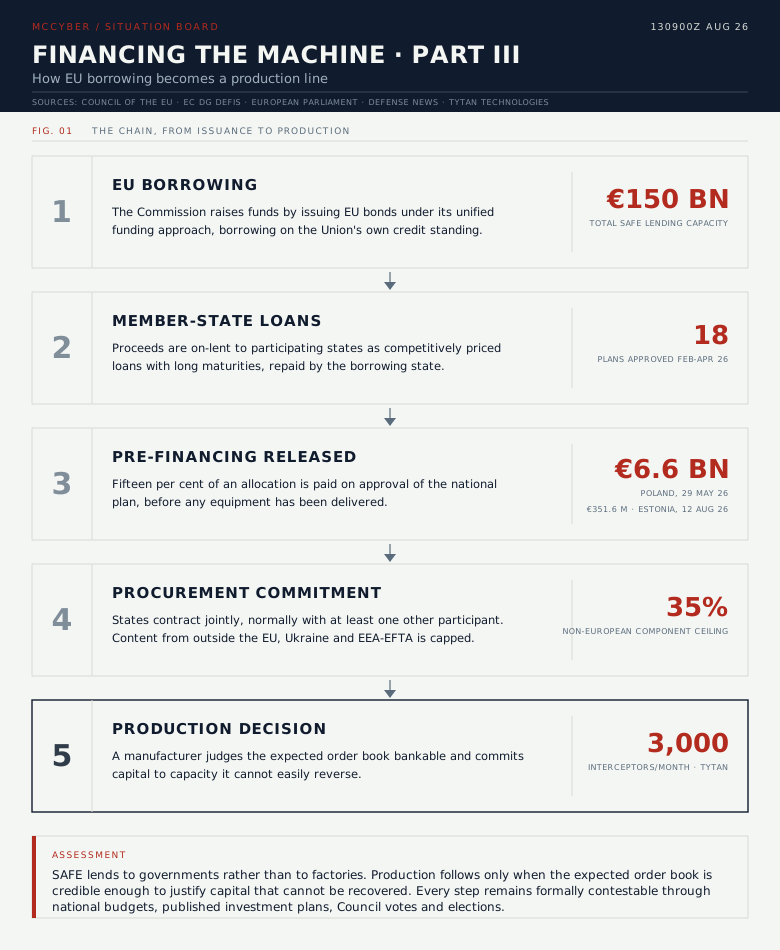
SAFE does not fund factories. It is funded by the EU issuing bonds under its existing unified funding approach, and it lends the proceeds to member states as competitively priced long-maturity loans that those member states repay. The money buys equipment through joint procurement, normally involving at least two participating countries, across a list that includes ammunition, air and missile defence, and small drones and anti-drone systems. Contracts must keep non-European content below 35 per cent of component costs, which caps rather than bars foreign participation and is designed to keep most of the industrial benefit inside the European and partner-country base.
The chain runs from EU borrowing to a member-state loan to a procurement commitment to an expected order book, and only then to somebody’s decision to build a plant. Between February and April this year the Council approved national defence investment plans for eighteen member states. Poland, the largest recipient at €43.7 billion, received €6.6 billion of pre-financing in May. Estonia received €351.6 million yesterday, fifteen per cent of its €2.3 billion allocation.
The arrangement described in the first essay in this series works on the same principle. Alphabet lowers the cost of building data centres it does not own by guaranteeing another company’s lease payments, and the EU lowers the cost of European rearmament by borrowing on its own strong credit and passing the proceeds down. Both use a stronger institution’s credit standing to lower the financing cost faced further down the chain. They are otherwise quite different instruments. Alphabet’s backstop is a privately negotiated contract carried at fair value in its own accounts, priced by the banks that demanded it. SAFE is public borrowing on-lent to governments, its risk resting on taxpayers, its allocation decided by Council implementing decisions and published national plans.
That difference is the point at which this stops being a finance story. SAFE enters through institutions that are at least formally contestable: national budgets, published investment plans, procurement decisions, Council votes and elections. The loans themselves survive a change of government, since they are legal obligations repaid over decades, and future procurement priorities do not. That combination makes European defence procurement maddeningly slow, and it also means the allocation of public risk has a route back into politics. The financing architecture around AI compute has no comparable route in. A guarantee negotiated between a hyperscaler, a developer and a bank syndicate is contestable only by the parties to it, and the retirement funds that eventually hold the resulting bonds were not in the room.
Subscribe
New essays and snapshots, by email, roughly weekly.
It is tempting to read all of this as Europe finally finding the cash. It never lacked the cash. The European Parliament’s own working through of the Draghi report records European household savings of €1.39 trillion in 2022 against €840 billion in the United States. It estimates that roughly €300 billion of European household investment goes outside the EU each year, mostly to America, and that around 70 per cent of EU corporate financing comes from bank borrowing while about 77 per cent of American corporate funding comes from capital markets. Draghi’s estimate of what Europe needs to invest annually to stay competitive, €750 to €800 billion, sits alongside a continent that saves more than that and routes a large slice of it elsewhere.
One scarce resource is a mechanism for concentrating capital quickly behind a single decision. America’s version of that mechanism is a deep, unified capital market sitting next to its technology industry. Europe’s has been twenty-seven national procurement systems, twenty-seven budget cycles and a bank-centred financial system that lends against collateral rather than against expected demand. The result is visible in where the money went: about 51 per cent of European NATO equipment spending between 2022 and 2024 was spent in the United States, up from 28 per cent in the preceding three years, on Bruegel’s figures. Europe was not short of money. It was short of European things to buy with it in the time available.
Analysis published by CEPR in June disputes the flight-of-savings story directly. The euro area’s net portfolio investment balance was recorded at minus €71 billion in 2025, following minus €42 billion in 2024, and the negative sign means inflows: non-residents invested more into euro area portfolio assets than residents invested outside. There is no evidence of capital fleeing the continent. The awkward part for anyone hoping to dismiss the argument on that basis is where the analysis lands, which is that European households hold too little in equities and that European equity markets remain too narrow and fragmented, leaving growth capital scarcer and dearer than it should be. The diagnosis changes. The conclusion barely does.
The sharper objection is that the reluctance may be information. If manufacturers and investors decline to commit to irreversible capacity, perhaps they are correctly reading a demand signal that remains politically provisional, in which case no financing instrument fixes it and building anyway would simply move the losses around.
There is a second objection, and it is the one European finance ministries will feel. SAFE is debt. Member states repay it, and a rearmament programme that reverses in five years leaves them with both the loans and the half-used factories. The industry’s caution about irreversible capacity has been vindicated before, most recently by the peace dividend that followed 1991. Nor does money resolve the physical bottlenecks. The European Defence Industry Programme’s €1.5 billion work programme, adopted in March, covers propellants, fuses and guided-munition assembly lines with deliveries expected from 2028, which is what “immediate” means once certification and permitting are counted.
Both objections are serious and neither changes the mechanism. Factories are built against expected orders. The useful question about Europe is no longer simply whether it has money, or whether it can invent things. It is now whether twenty-seven governments can make promises about future purchasing that a manufacturer, and the bank behind it, will treat as bankable. Tytan’s line is scheduled to reach three thousand interceptors a month by December. Whether it does will say more about European industrial capacity than any of the announcements that preceded it.
Sources: Council of the European Union; European Commission Directorate-General for Defence Industry and Space; European Parliament; NATO Innovation Fund and Dealroom; Defense News; Tytan Technologies; CEPR; Bruegel via CEPA; Air Street Press; Defence24.
Subscribe
McCyber intelligence briefings and structural essays, directly. No institutional spin.