Why geothermal power still begins with a very expensive hole
In Lanzarote, the residual heat of an eighteenth-century eruption cooks lunch for tourists. A few hundred kilometres west, an Icelandic-led consortium has begun drilling beneath Tenerife to find out whether the same kind of heat can carry an island's electricity system — with roughly half the exploration bill paid by the public.
Listen to this briefing
Why geothermal power still begins with a very expensive hole.
In Lanzarote, the residual heat of an eighteenth-century eruption cooks lunch for tourists. A few hundred kilometres west, an Icelandic-led consortium has begun drilling beneath Tenerife to find out whether the same kind of heat can carry an island's electricity system — with roughly half the exploration bill paid by the public.
The museum beneath Jameos
Most visitors to Jameos del Agua go for the César Manrique of it — a lava tube from the Corona volcano opened up into a white cavern, an improbable blue pool, a blind albino crab that lives in the tidal lake and nowhere else on Earth.
Fewer buy the extra ticket for the Casa de los Volcanes, which occupies part of the same tube. That is a shame, because it is the part of the site doing science rather than architecture. The Cabildo of Lanzarote established it in 1987 at the urging of volcanologists who had been surveying the Canaries since the 1970s, and the institutions that grew out of that work are now partners in Tenerife's geothermal exploration programme. The connection matters later.
It is a museum bolted onto a working observatory. Since 1986 the associated Geo-science Laboratory has maintained permanent instrument modules in three places on the island — here, in the Cueva de los Verdes, and at the old camel-drivers' house inside Timanfaya National Park — with data returning to Jameos. Gravimeters, tiltmeters, thermal records. Decades of them.
What a visitor takes from that, paying attention, is not that volcanoes are dramatic. It is that the heat under this island is a measurable and persistent property of the ground, rather than a passing spell of weather. It varies, and volcanic systems do change over time, but it does not stop at night.
That distinction is the whole commercial case for geothermal energy, and it explains why the industry behaves so unlike every other renewable.
The grill at Timanfaya
If Jameos makes the argument quietly, Timanfaya makes it as theatre.
The eruptions of 1730–36 buried roughly a quarter of Lanzarote and rank among the largest basaltic events in recorded European history. Nearly three centuries later the ground has not finished cooling. On the Islote de Hilario, park staff drop dry brushwood into a shallow pit and it ignites within seconds; they pour cold water into a borehole and it returns as a jet of steam. A few metres down the anomaly runs at around 250°C, and readings above 600°C have been recorded deeper still. Manrique's El Diablo restaurant sits on top of it, grilling meat and fish over a five-metre well without gas or electric heating.
It is a magic trick performed on a coach timetable, and also the simplest available demonstration of what geothermal offers. That grill is hot at three in the morning. It is hot in January. It is hot when there is no wind, no sun and the fuel ships are late.
Industry calls this quality firm, or dispatchable. As grids take on larger shares of wind and solar, low-carbon firm generation is becoming steadily more valuable. Yet geothermal remains a minor part of global generation.
Three kinds of geothermal
Three things are routinely conflated, including in much of the coverage, and separating them makes the rest of this easier.
Conventional (hydrothermal) geothermal drills into naturally occurring hot water or steam. Iceland, Kenya and the Philippines run on it, and it is what the Tenerife programme is looking for.
Enhanced geothermal systems (EGS) drill into rock that is hot but relatively dry and impermeable, then fracture it under pressure to create pathways for water to circulate. Newer, riskier, and the reason geothermal is suddenly interesting outside volcanic regions.
Binary-cycle describes what happens above ground, not below it. Heat from the geothermal fluid transfers to a secondary working fluid that drives the turbine, and the geothermal water is reinjected without ever being vented. Either kind of reservoir can feed a binary plant.
Their costs, emissions and hazards are not the same, which is why the distinction keeps mattering below.
Why it stays small
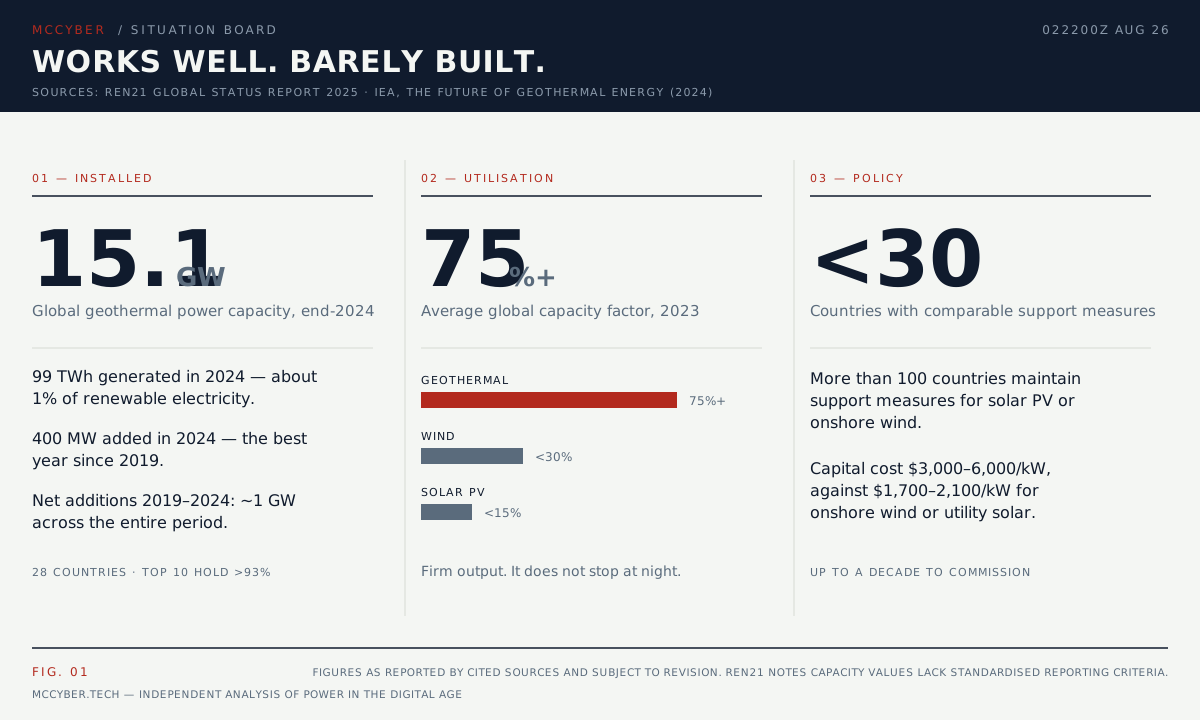
Global installed geothermal power capacity stands at around 15.1 GW, generating an estimated 99 TWh in 2024 — roughly 1% of global renewable electricity, across at least 28 countries, with the top ten holding more than 93% of capacity. In 2024 the world added about that much solar capacity every fortnight. Geothermal added 400 MW, and that was the best year since 2019; net additions across the whole 2019–2024 period came to around 1 GW. There is a larger direct-heat business alongside it, supplying an estimated 245 TWh in 2024, concentrated in China, Türkiye, Iceland and Japan — a figure that excludes ground-source heat pumps, which are counted separately.
None of this reflects poor performance. Global geothermal capacity ran at a utilisation rate above 75% in 2023, against under 30% for wind and under 15% for solar PV. Where conditions suit it, geothermal becomes a major part of the electricity system: close to 40% of generation in Kenya, nearly 18% in New Zealand, and roughly a quarter in Iceland, where it also meets almost all heat demand. Kenya is the clearest case of geothermal working as a grid backbone; Icelandic electricity is still dominated by hydropower.
Nor is the resource small. The IEA's assessment, produced with Project InnerSpace, is that the technical potential of next-generation geothermal is second only to solar PV among renewables — enough in principle to meet global electricity demand around 140 times over — and that drilling beyond three kilometres opens usable heat under nearly every country on Earth. Technical potential is not commercial availability: permeability, water, drilling conditions, transmission and local demand all still determine whether a site is worth anything. But no country's problem is a total absence of heat.
What holds it back is the shape of the risk.
A solar developer does not need to prove the sun is there. A geothermal developer spends a large share of a project's capital before knowing whether there is a commercial resource, at capital costs of roughly $3,000–6,000/kW against $1,700–2,100 for onshore wind or utility solar. Timelines compound it — the IEA reckons a project can take up to a decade to commission, and Japan's 14.9 MW Appi plant, completed in 2024, took twenty years from survey to operation. Cheap gas, thin drilling supply chains outside oil regions, declining steam output at ageing fields and the rapid fall in the cost of solar and battery storage have all worked against it too.
Policy support shows the same disparity. More than 100 countries have support measures for solar or onshore wind; fewer than 30 have comparable measures for geothermal. Where governments have engaged, it has often been precisely to address the exploration problem — Türkiye revised its geothermal feed-in tariff in 2023 after the original proved inadequate to project risk, and the Philippine government spent 2024 developing financing facilities specifically to de-risk future drilling.
The environmental costs
Geothermal's clean-energy credentials are real but conditional, and the case is weaker if you skip this part.
At its best it sits in the lowest band of lifecycle emissions for any generation technology. Some binary-cycle plants, which keep the geothermal fluid in a closed loop, have been assessed at around 5.7 gCO₂eq/kWh — essentially all of it drilling and construction.
At its worst it is not clean at all. Geothermal fluids carry non-condensable gases, mostly CO₂ released from carbonate rock, and open-cycle flash plants vent them. In Western Anatolia, Türkiye, plants using open cycles have been measured emitting 900–1,300 gCO₂/kWh — coal-plant territory, from assets counted as renewable in national statistics.
The mitigation is real and now being deployed. New Zealand's Tauhara binary unit, one of the world's largest, is designed to reinject all its CO₂ into the reservoir, and national geothermal emissions there have been falling as gas-reinjection retrofits reach older plants. But neither closed-loop conversion nor gas reinjection is free: binary designs carry efficiency and cost penalties at high-temperature resources, and reinjection is not yet routine practice across the industry.
A second cost is seismic, and it attaches specifically to reservoir stimulation rather than to geothermal generally. Injecting fluid at pressure into hot rock raises pore pressure in nearby faults. Basel's EGS project in Switzerland was abandoned after an ML 3.4 event. Pohang, in South Korea, produced an Mw 5.5 earthquake in November 2017 — the second largest in the country's modern instrumental record. Reported injuries range from 82 to 135 depending on source and period; there were no deaths. Between 1,500 and 1,800 people were displaced into emergency shelters. South Korea's official 2017 Pohang Earthquake White Paper records damage to 56,622 private properties and 417 public facilities, with property damage of roughly 85 billion won; the government investigation team put the cost at about $75 million, while the Science papers reporting the induced-seismicity finding cited $52 million. That investigation concluded in 2019 that injection at the geothermal project had triggered the quake, and the project was permanently suspended.
Fault screening, conservative injection limits and traffic-light protocols can reduce this risk substantially. They are not guarantees. Pohang failed with monitoring already in place, because the thresholds were poorly designed and the geology incompletely understood. These systems depend on good subsurface data, cautious limits, and regulators willing to stop a project that is earning money.
What drilling has changed
Two developments are converging.
EGS is reaching commercial scale, using horizontal drilling and multistage stimulation developed in North American shale. Fervo Energy's Cape Station in Utah expects to begin delivering to the grid in late 2026 and to reach about 100 MW by early 2027, with a further 400 MW targeted for 2028. It would not be the first EGS project anywhere — Soultz-sous-Forêts in France, and Landau and Insheim in Germany, came earlier at much smaller scale and under contested definitions — but it would be the first deployment of the shale-derived generation of EGS at genuine utility scale.
Technology companies are driving much of the commercial interest. Fervo has already supplied power in Nevada through the Google-backed Project Red pilot, and has since agreed a further 115 MW in the state with NV Energy. Data centre operators want round-the-clock low-carbon power, and the list of things that sell it is short.
The second development is a transfer of capability from oil and gas. Drilling and well construction account for much of a geothermal project's cost, and the IEA's judgement is that up to 80% of the investment required involves capability and skills already common in the oil and gas industry — rigs, subsurface modelling, well services, supply chains, people. On that basis it projects that next-generation geothermal costs could fall by around 80% by 2035, to roughly $50/MWh, placing it among the cheapest dispatchable low-carbon sources available. The IEA's upper case is 800 GW of capacity and up to 15% of global electricity demand growth to 2050.
Whether that happens depends less on geology than on who is willing to fund the wells that fail.
Tenerife takes the risk
Which is why the Canaries are worth watching. They are running that experiment now.
The dependency is officially documented. According to the Instituto Canario de Estadística, petroleum products accounted for 79.2% of electricity generated in the archipelago in 2025, with renewables at 20.8% — a share that has barely shifted in several years. There is no hydro to speak of. Land for new wind and solar is increasingly contested on islands where every hectare is fought over between tourism, agriculture and conservation, and geothermal uses roughly a tenth of the land per unit of output. A geothermal well also cannot be embargoed, interdicted or repriced from outside the islands, which is an energy-security argument as much as a climate one.
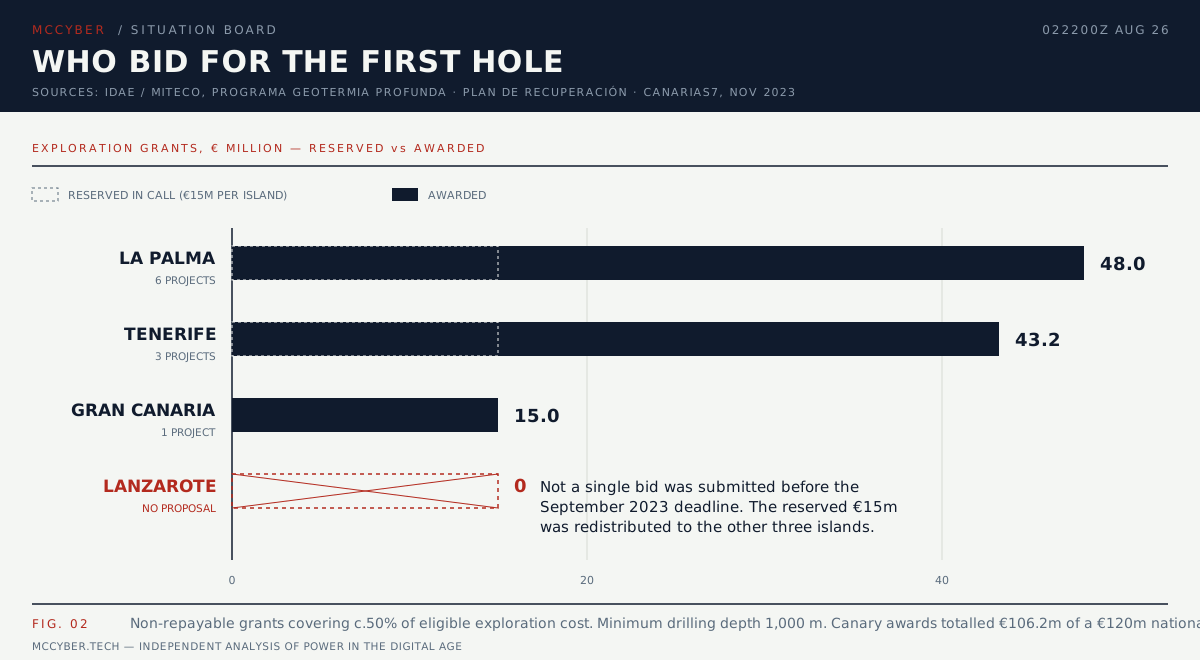
Money arrived before drills did. Spain's IDAE ran a €120 million call under the GEOTERMIA PROFUNDA programme, funded through the Recovery, Transformation and Resilience Plan. Canarian projects took €106.2 million of it across ten awards — €48 million to six projects in La Palma, €43.2 million to three in Tenerife, €15 million to one in Gran Canaria. These are non-repayable grants covering roughly half the eligible cost of exploration work, not construction subsidies for power plants, and every funded project must drill to at least 1,000 metres.
Lanzarote is a curious absence. The original call ring-fenced €15 million each for La Palma, Tenerife, Gran Canaria and Lanzarote — but not a single proposal was submitted for Lanzarote before the September 2023 deadline, which is why the other three islands could absorb the money. The island that demonstrates geothermal heat to coach parties every day put in no bid for the funds set aside to investigate it. Much of its most conspicuous anomaly sits inside Timanfaya National Park and a UNESCO biosphere reserve; local interest has since surfaced, and so has local opposition.
Drilling began in mid-May 2026 at Vilaflor, on the southern flank of the Teide system, targeting depths of 2,500–3,000 metres. Mariano Hernández Zapata, the Canary Islands Minister for Ecological Transition and Energy, has said surface studies indicate a better than 60% probability that the site will yield thermal water at 150°C or above — a resource-temperature threshold, not a forecast of commercial generation. Each well is expected to take four to five months.
The operator, Energía Geotérmica de Canarias, was formed in May 2025 by Iceland's Reykjavík Geothermal, the Canarian energy group DISA, and two public science bodies, ITER and Involcan — the latter having grown out of the Canaries' long tradition of volcanic monitoring, the same tradition that produced the Casa de los Volcanes. Marriott Drilling is providing rig services. Exploration licences have also been awarded on La Palma, and Repsol holds concessions of its own.
Read that consortium and the global pattern is visible in miniature: an Icelandic firm exporting four decades of hard-won drilling competence, a domestic fuel distributor diversifying beyond the products its present revenue depends on, and a public research institute using fifty years of monitoring to decide where to put the bit. The instruments came first, by a very long way.
The permitting question
One aspect deserves precision rather than alarm, because the loose version is already circulating.
On 28 April 2025 the Consejo de Gobierno of the Canary Islands excluded the "Sondeo TF-Sur" exploratory drilling project from the simplified environmental impact assessment procedure under Spain's Ley 21/2013 — not from environmental assessment altogether, and an alternative set of conditions applies. The legal basis is EU Regulation 2022/2577, the emergency framework for accelerating renewable deployment, together with Article 22 of Real Decreto-ley 20/2022, which substitutes an environmental-affection determination for the ordinary procedure. The decision was published in the Boletín Oficial de Canarias on 6 May 2025. The government's argument was that applying the ordinary procedure could frustrate a renewable project intended to reduce the islands' fossil dependence, and it recorded that none of the planned boreholes falls within the Canary protected natural spaces network or Natura 2000.
That position is defensible and should be judged on its own terms. Exploratory hydrothermal drilling is not the high-pressure reservoir stimulation that caused Pohang, and it would be wrong to imply the hazards are equivalent. But geothermal projects can still affect groundwater and landscape, and — if development later requires reinjection or stimulation — seismicity. The exemption covers exploration. No production project yet exists, so the procedure and conditions attaching to any later development remain to be determined, and that is the more consequential decision.
Who pays for the first well
In the Canaries, the first answer is: the public. The grants cover roughly half the eligible exploration cost, socialising part of the loss before anyone knows whether commercial generation is possible. That is a reasonable response to the problem this article has been describing — the exploration risk that has kept geothermal marginal for forty years is exactly the risk that public money is well suited to absorb.
It raises the other half of the question. If the well fails, the grant takes part of the hit. If it succeeds, IDAE's own framing is explicit that a positive result gives the promoters access, at a later stage, to exploitation of the resource. Whether the public obtains a proportionate return on that — through equity, royalties, licence conditions, or ownership of the geological data its money produced — is not something the funding announcements address, and it is not a question that gets easier once wells are producing. Nor is it settled who carries long-term liability for restoration and well integrity, or what happens if a well succeeds technically and is then shelved commercially.
Stand on the Islote de Hilario and none of this is visible. The heat that flash-boils a bucket of water has been under that hill continuously since 1730, indifferent to weather, fuel markets and shipping lanes.
The reason it powers a restaurant grill rather than an island was never that the physics were unclear; the Casa de los Volcanes has been logging the evidence since 1986. The reason is that the first hole is expensive, may produce nothing, and has usually left whoever drilled it carrying the loss. Governments and companies have paid for plenty of first holes over four decades, and the failure record is itself part of why capital remains costly.
What has changed is that shale drillers, hyperscalers and island governments have run out of cheaper options, and public money is now absorbing part of the exploration risk directly — €106 million of it in the Canaries, before a single megawatt exists.
The question for the next five years is not whether the heat is there. Every visitor to Timanfaya can confirm that, at some cost to their eyebrows. It is who carries the risk of the well that comes back dry, and what they get if it doesn't.
---
Sources
Lanzarote: CACT Lanzarote and Geoparque Lanzarote — Casa de los Volcanes, Geo-science Laboratory (est. 1986), Jameos del Agua, Islote de Hilario and El Diablo.
Global figures: REN21, Renewables 2025 Global Status Report (geothermal module) — 15.1 GW installed, 99 TWh generation, 400 MW added in 2024, 245 TWh direct-use heat excluding ground-source heat pumps, New Zealand and Türkiye detail, Philippine de-risking facilities, Japan's Appi timeline. IEA, The Future of Geothermal Energy (2024) — technical potential, utilisation rates, permitting timelines, cost trajectory, oil and gas overlap, policy coverage. EIA and Kenyan EPRA — national generation shares.
Emissions: Argonne National Laboratory via the Geothermal Energy Association — binary plant lifecycle emissions. Springer, Global CO₂ Capture and Storage Methods… A Case Study from Turkey — open-cycle emissions in Western Anatolia.
Pohang and Basel: Geological Society of Korea-led government investigation (March 2019); 2017 Pohang Earthquake White Paper (damage counts); Kim et al. and Grigoli et al., Science (2018); Zhou et al., Reviews of Geophysics (2024) on induced-seismicity governance. Note: the Zhou et al. review states that a fatality resulted from the Pohang earthquake; this is not supported by the government investigation, contemporary reporting or subsequent summaries, all of which record injuries but no deaths.
EGS commercialisation: Fervo Energy and Cape Station project statements; Canary Media.
Canary Islands: Instituto Canario de Estadística (ISTAC), Estadística de Energía Eléctrica 2025 — generation by source. IDAE, MITECO and Plan de Recuperación — GEOTERMIA PROFUNDA call terms, per-island allocation, award breakdown, minimum drilling depth, and subsequent-exploitation provision; Canarias7 (November 2023) on the absence of any Lanzarote submission. Boletín Oficial de Canarias nº 89, 6 May 2025 — TF-Sur exclusion from simplified EIA. Reykjavík Geothermal, ThinkGeoEnergy and Canarian regional government statements — drilling programme, consortium, depths and temperature target.
Enable JavaScript and use a browser with spoken audio support to listen.
Read aloud by your browser. Voice and availability depend on your device.
Geothermal runs at a higher capacity factor than any other renewable, and is barely deployed. Sources: REN21 Global Status Report 2025; IEA, The Future of Geothermal Energy (2024).
The museum beneath Jameos
Most visitors to Jameos del Agua go for the César Manrique of it — a lava tube from the Corona volcano opened up into a white cavern, an improbable blue pool, a blind albino crab that lives in the tidal lake and nowhere else on Earth.
Fewer buy the extra ticket for the Casa de los Volcanes, which occupies part of the same tube. That is a shame, because it is the part of the site doing science rather than architecture. The Cabildo of Lanzarote established it in 1987 at the urging of volcanologists who had been surveying the Canaries since the 1970s, and the institutions that grew out of that work are now partners in Tenerife’s geothermal exploration programme. The connection matters later.
It is a museum bolted onto a working observatory. Since 1986 the associated Geo-science Laboratory has maintained permanent instrument modules in three places on the island — here, in the Cueva de los Verdes, and at the old camel-drivers’ house inside Timanfaya National Park — with data returning to Jameos. Gravimeters, tiltmeters, thermal records. Decades of them.
What a visitor takes from that, paying attention, is not that volcanoes are dramatic. It is that the heat under this island is a measurable and persistent property of the ground, rather than a passing spell of weather. It varies, and volcanic systems do change over time, but it does not stop at night.
That distinction is the whole commercial case for geothermal energy, and it explains why the industry behaves so unlike every other renewable.
The grill at Timanfaya
If Jameos makes the argument quietly, Timanfaya makes it as theatre.
The eruptions of 1730–36 buried roughly a quarter of Lanzarote and rank among the largest basaltic events in recorded European history. Nearly three centuries later the ground has not finished cooling. On the Islote de Hilario, park staff drop dry brushwood into a shallow pit and it ignites within seconds; they pour cold water into a borehole and it returns as a jet of steam. A few metres down the anomaly runs at around 250°C, and readings above 600°C have been recorded deeper still. Manrique’s El Diablo restaurant sits on top of it, grilling meat and fish over a five-metre well without gas or electric heating.
It is a magic trick performed on a coach timetable, and also the simplest available demonstration of what geothermal offers. That grill is hot at three in the morning. It is hot in January. It is hot when there is no wind, no sun and the fuel ships are late.
Industry calls this quality firm, or dispatchable. As grids take on larger shares of wind and solar, low-carbon firm generation is becoming steadily more valuable. Yet geothermal remains a minor part of global generation.
Three kinds of geothermal
Three things are routinely conflated, including in much of the coverage, and separating them makes the rest of this easier.
Conventional (hydrothermal) geothermal drills into naturally occurring hot water or steam. Iceland, Kenya and the Philippines run on it, and it is what the Tenerife programme is looking for.
Enhanced geothermal systems (EGS) drill into rock that is hot but relatively dry and impermeable, then fracture it under pressure to create pathways for water to circulate. Newer, riskier, and the reason geothermal is suddenly interesting outside volcanic regions.
Binary-cycle describes what happens above ground, not below it. Heat from the geothermal fluid transfers to a secondary working fluid that drives the turbine, and the geothermal water is reinjected without ever being vented. Either kind of reservoir can feed a binary plant.
Their costs, emissions and hazards are not the same, which is why the distinction keeps mattering below.
Why it stays small
Global installed geothermal power capacity stands at around 15.1 GW, generating an estimated 99 TWh in 2024 — roughly 1% of global renewable electricity, across at least 28 countries, with the top ten holding more than 93% of capacity. In 2024 the world added about that much solar capacity every fortnight. Geothermal added 400 MW, and that was the best year since 2019; net additions across the whole 2019–2024 period came to around 1 GW. There is a larger direct-heat business alongside it, supplying an estimated 245 TWh in 2024, concentrated in China, Türkiye, Iceland and Japan — a figure that excludes ground-source heat pumps, which are counted separately.
None of this reflects poor performance. Global geothermal capacity ran at a utilisation rate above 75% in 2023, against under 30% for wind and under 15% for solar PV. Where conditions suit it, geothermal becomes a major part of the electricity system: close to 40% of generation in Kenya, nearly 18% in New Zealand, and roughly a quarter in Iceland, where it also meets almost all heat demand. Kenya is the clearest case of geothermal working as a grid backbone; Icelandic electricity is still dominated by hydropower.
Nor is the resource small. The IEA’s assessment, produced with Project InnerSpace, is that the technical potential of next-generation geothermal is second only to solar PV among renewables — enough in principle to meet global electricity demand around 140 times over — and that drilling beyond three kilometres opens usable heat under nearly every country on Earth. Technical potential is not commercial availability: permeability, water, drilling conditions, transmission and local demand all still determine whether a site is worth anything. But no country’s problem is a total absence of heat.
What holds it back is the shape of the risk.
A solar developer does not need to prove the sun is there. A geothermal developer spends a large share of a project’s capital before knowing whether there is a commercial resource, at capital costs of roughly $3,000–6,000/kW against $1,700–2,100 for onshore wind or utility solar. Timelines compound it — the IEA reckons a project can take up to a decade to commission, and Japan’s 14.9 MW Appi plant, completed in 2024, took twenty years from survey to operation. Cheap gas, thin drilling supply chains outside oil regions, declining steam output at ageing fields and the rapid fall in the cost of solar and battery storage have all worked against it too.
Policy support shows the same disparity. More than 100 countries have support measures for solar or onshore wind; fewer than 30 have comparable measures for geothermal. Where governments have engaged, it has often been precisely to address the exploration problem — Türkiye revised its geothermal feed-in tariff in 2023 after the original proved inadequate to project risk, and the Philippine government spent 2024 developing financing facilities specifically to de-risk future drilling.
The environmental costs
Geothermal’s clean-energy credentials are real but conditional, and the case is weaker if you skip this part.
At its best it sits in the lowest band of lifecycle emissions for any generation technology. Some binary-cycle plants, which keep the geothermal fluid in a closed loop, have been assessed at around 5.7 gCO₂eq/kWh — essentially all of it drilling and construction.
At its worst it is not clean at all. Geothermal fluids carry non-condensable gases, mostly CO₂ released from carbonate rock, and open-cycle flash plants vent them. In Western Anatolia, Türkiye, plants using open cycles have been measured emitting 900–1,300 gCO₂/kWh — coal-plant territory, from assets counted as renewable in national statistics.
The mitigation is real and now being deployed. New Zealand’s Tauhara binary unit, one of the world’s largest, is designed to reinject all its CO₂ into the reservoir, and national geothermal emissions there have been falling as gas-reinjection retrofits reach older plants. But neither closed-loop conversion nor gas reinjection is free: binary designs carry efficiency and cost penalties at high-temperature resources, and reinjection is not yet routine practice across the industry.
A second cost is seismic, and it attaches specifically to reservoir stimulation rather than to geothermal generally. Injecting fluid at pressure into hot rock raises pore pressure in nearby faults. Basel’s EGS project in Switzerland was abandoned after an ML 3.4 event. Pohang, in South Korea, produced an Mw 5.5 earthquake in November 2017 — the second largest in the country’s modern instrumental record. Reported injuries range from 82 to 135 depending on source and period; there were no deaths. Between 1,500 and 1,800 people were displaced into emergency shelters. South Korea’s official 2017 Pohang Earthquake White Paper records damage to 56,622 private properties and 417 public facilities, with property damage of roughly 85 billion won; the government investigation team put the cost at about $75 million, while the Science papers reporting the induced-seismicity finding cited $52 million. That investigation concluded in 2019 that injection at the geothermal project had triggered the quake, and the project was permanently suspended.
Fault screening, conservative injection limits and traffic-light protocols can reduce this risk substantially. They are not guarantees. Pohang failed with monitoring already in place, because the thresholds were poorly designed and the geology incompletely understood. These systems depend on good subsurface data, cautious limits, and regulators willing to stop a project that is earning money.
What drilling has changed
Two developments are converging.
EGS is reaching commercial scale, using horizontal drilling and multistage stimulation developed in North American shale. Fervo Energy’s Cape Station in Utah expects to begin delivering to the grid in late 2026 and to reach about 100 MW by early 2027, with a further 400 MW targeted for 2028. It would not be the first EGS project anywhere — Soultz-sous-Forêts in France, and Landau and Insheim in Germany, came earlier at much smaller scale and under contested definitions — but it would be the first deployment of the shale-derived generation of EGS at genuine utility scale.
Technology companies are driving much of the commercial interest. Fervo has already supplied power in Nevada through the Google-backed Project Red pilot, and has since agreed a further 115 MW in the state with NV Energy. Data centre operators want round-the-clock low-carbon power, and the list of things that sell it is short.
The second development is a transfer of capability from oil and gas. Drilling and well construction account for much of a geothermal project’s cost, and the IEA’s judgement is that up to 80% of the investment required involves capability and skills already common in the oil and gas industry — rigs, subsurface modelling, well services, supply chains, people. On that basis it projects that next-generation geothermal costs could fall by around 80% by 2035, to roughly $50/MWh, placing it among the cheapest dispatchable low-carbon sources available. The IEA’s upper case is 800 GW of capacity and up to 15% of global electricity demand growth to 2050.
Whether that happens depends less on geology than on who is willing to fund the wells that fail.
Subscribe
New essays and snapshots, by email, roughly weekly.
Tenerife takes the risk
Which is why the Canaries are worth watching. They are running that experiment now.
The dependency is officially documented. According to the Instituto Canario de Estadística, petroleum products accounted for 79.2% of electricity generated in the archipelago in 2025, with renewables at 20.8% — a share that has barely shifted in several years. There is no hydro to speak of. Land for new wind and solar is increasingly contested on islands where every hectare is fought over between tourism, agriculture and conservation, and geothermal uses roughly a tenth of the land per unit of output. A geothermal well also cannot be embargoed, interdicted or repriced from outside the islands, which is an energy-security argument as much as a climate one.
Money arrived before drills did. Spain’s IDAE ran a €120 million call under the GEOTERMIA PROFUNDA programme, funded through the Recovery, Transformation and Resilience Plan. Canarian projects took €106.2 million of it across ten awards — €48 million to six projects in La Palma, €43.2 million to three in Tenerife, €15 million to one in Gran Canaria. These are non-repayable grants covering roughly half the eligible cost of exploration work, not construction subsidies for power plants, and every funded project must drill to at least 1,000 metres.
Lanzarote is a curious absence. The original call ring-fenced €15 million each for La Palma, Tenerife, Gran Canaria and Lanzarote — but not a single proposal was submitted for Lanzarote before the September 2023 deadline, which is why the other three islands could absorb the money. The island that demonstrates geothermal heat to coach parties every day put in no bid for the funds set aside to investigate it. Much of its most conspicuous anomaly sits inside Timanfaya National Park and a UNESCO biosphere reserve; local interest has since surfaced, and so has local opposition.
Situation board comparing the Canary Islands' deep geothermal exploration grants, reserved versus awarded. Spain's IDAE GEOTERMIA PROFUNDA call reserved €15 million for each of four Canary islands. La Palma was awarded €48 million across six projects, Tenerife €43.2 million across three, and Gran Canaria €15 million across one. Lanzarote was awarded nothing, because no proposal was submitted before the September 2023 deadline, and its reserved sum was redistributed to the other three.
Drilling began in mid-May 2026 at Vilaflor, on the southern flank of the Teide system, targeting depths of 2,500–3,000 metres. Mariano Hernández Zapata, the Canary Islands Minister for Ecological Transition and Energy, has said surface studies indicate a better than 60% probability that the site will yield thermal water at 150°C or above — a resource-temperature threshold, not a forecast of commercial generation. Each well is expected to take four to five months.
The operator, Energía Geotérmica de Canarias, was formed in May 2025 by Iceland’s Reykjavík Geothermal, the Canarian energy group DISA, and two public science bodies, ITER and Involcan — the latter having grown out of the Canaries’ long tradition of volcanic monitoring, the same tradition that produced the Casa de los Volcanes. Marriott Drilling is providing rig services. Exploration licences have also been awarded on La Palma, and Repsol holds concessions of its own.
Read that consortium and the global pattern is visible in miniature: an Icelandic firm exporting four decades of hard-won drilling competence, a domestic fuel distributor diversifying beyond the products its present revenue depends on, and a public research institute using fifty years of monitoring to decide where to put the bit. The instruments came first, by a very long way.
The permitting question
One aspect deserves precision rather than alarm, because the loose version is already circulating.
On 28 April 2025 the Consejo de Gobierno of the Canary Islands excluded the “Sondeo TF-Sur” exploratory drilling project from the simplified environmental impact assessment procedure under Spain’s Ley 21/2013 — not from environmental assessment altogether, and an alternative set of conditions applies. The legal basis is EU Regulation 2022/2577, the emergency framework for accelerating renewable deployment, together with Article 22 of Real Decreto-ley 20/2022, which substitutes an environmental-affection determination for the ordinary procedure. The decision was published in the Boletín Oficial de Canarias on 6 May 2025. The government’s argument was that applying the ordinary procedure could frustrate a renewable project intended to reduce the islands’ fossil dependence, and it recorded that none of the planned boreholes falls within the Canary protected natural spaces network or Natura 2000.
That position is defensible and should be judged on its own terms. Exploratory hydrothermal drilling is not the high-pressure reservoir stimulation that caused Pohang, and it would be wrong to imply the hazards are equivalent. But geothermal projects can still affect groundwater and landscape, and — if development later requires reinjection or stimulation — seismicity. The exemption covers exploration. No production project yet exists, so the procedure and conditions attaching to any later development remain to be determined, and that is the more consequential decision.
Who pays for the first well
In the Canaries, the first answer is: the public. The grants cover roughly half the eligible exploration cost, socialising part of the loss before anyone knows whether commercial generation is possible. That is a reasonable response to the problem this article has been describing — the exploration risk that has kept geothermal marginal for forty years is exactly the risk that public money is well suited to absorb.
It raises the other half of the question. If the well fails, the grant takes part of the hit. If it succeeds, IDAE’s own framing is explicit that a positive result gives the promoters access, at a later stage, to exploitation of the resource. Whether the public obtains a proportionate return on that — through equity, royalties, licence conditions, or ownership of the geological data its money produced — is not something the funding announcements address, and it is not a question that gets easier once wells are producing. Nor is it settled who carries long-term liability for restoration and well integrity, or what happens if a well succeeds technically and is then shelved commercially.
Stand on the Islote de Hilario and none of this is visible. The heat that flash-boils a bucket of water has been under that hill continuously since 1730, indifferent to weather, fuel markets and shipping lanes.
The reason it powers a restaurant grill rather than an island was never that the physics were unclear; the Casa de los Volcanes has been logging the evidence since 1986. The reason is that the first hole is expensive, may produce nothing, and has usually left whoever drilled it carrying the loss. Governments and companies have paid for plenty of first holes over four decades, and the failure record is itself part of why capital remains costly.
What has changed is that shale drillers, hyperscalers and island governments have run out of cheaper options, and public money is now absorbing part of the exploration risk directly — €106 million of it in the Canaries, before a single megawatt exists.
The question for the next five years is not whether the heat is there. Every visitor to Timanfaya can confirm that, at some cost to their eyebrows. It is who carries the risk of the well that comes back dry, and what they get if it doesn’t.
Sources
Lanzarote: CACT Lanzarote and Geoparque Lanzarote — Casa de los Volcanes, Geo-science Laboratory (est. 1986), Jameos del Agua, Islote de Hilario and El Diablo.
Global figures: REN21, Renewables 2025 Global Status Report (geothermal module) — 15.1 GW installed, 99 TWh generation, 400 MW added in 2024, 245 TWh direct-use heat excluding ground-source heat pumps, New Zealand and Türkiye detail, Philippine de-risking facilities, Japan’s Appi timeline. IEA, The Future of Geothermal Energy (2024) — technical potential, utilisation rates, permitting timelines, cost trajectory, oil and gas overlap, policy coverage. EIA and Kenyan EPRA — national generation shares.
Emissions: Argonne National Laboratory via the Geothermal Energy Association — binary plant lifecycle emissions. Springer, Global CO₂ Capture and Storage Methods… A Case Study from Turkey — open-cycle emissions in Western Anatolia.
Pohang and Basel: Geological Society of Korea-led government investigation (March 2019); 2017 Pohang Earthquake White Paper (damage counts); Kim et al. and Grigoli et al., Science (2018); Zhou et al., Reviews of Geophysics (2024) on induced-seismicity governance. Note: the Zhou et al. review states that a fatality resulted from the Pohang earthquake; this is not supported by the government investigation, contemporary reporting or subsequent summaries, all of which record injuries but no deaths.
EGS commercialisation: Fervo Energy and Cape Station project statements; Canary Media.
Canary Islands: Instituto Canario de Estadística (ISTAC), Estadística de Energía Eléctrica 2025 — generation by source. IDAE, MITECO and Plan de Recuperación — GEOTERMIA PROFUNDA call terms, per-island allocation, award breakdown, minimum drilling depth, and subsequent-exploitation provision; Canarias7 (November 2023) on the absence of any Lanzarote submission. Boletín Oficial de Canarias nº 89, 6 May 2025 — TF-Sur exclusion from simplified EIA. Reykjavík Geothermal, ThinkGeoEnergy and Canarian regional government statements — drilling programme, consortium, depths and temperature target.