Maven's AI agents: who is accountable when they fail?
Anthropic told courts it cannot alter Claude once it is inside a classified Pentagon system, and an appeals court has now ruled that how…
Ukraine's Starshield episode shows that a satellite terminal on a drone is a dependency someone else can adjust, and that Europe has no ready replacement. The harder question is operational resilience: which missions survive losing the link.
Enable JavaScript and use a browser with spoken audio support to listen.
Read aloud by your browser. Voice and availability depend on your device.
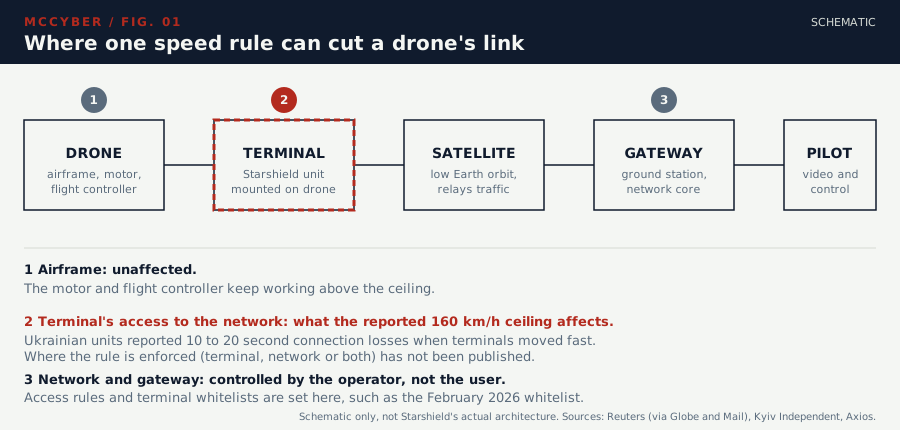
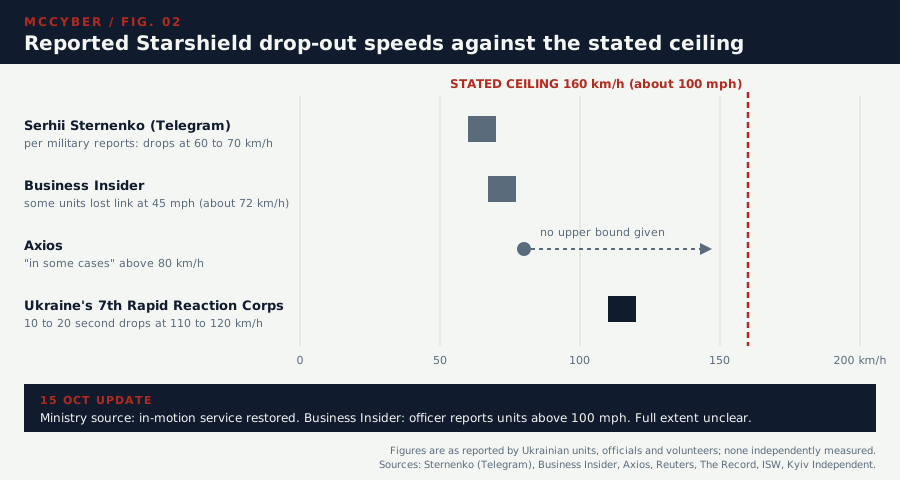
On the night of 13–14 October, military Starshield terminals on Ukrainian drones began dropping their connection. Ukraine’s 7th Rapid Reaction Corps reported 10 to 20 second losses at speeds of only 110 to 120 km/h, according to Reuters (also carried by the Globe and Mail) and The Record, and the drones kept flying but became harder to control. Presidential adviser Serhiy Beskrestnov said SpaceX imposed a ceiling of 160 km/h (about 100 mph) on moving terminals without warning. Who ordered it, and why, is disputed and is not the subject here. What matters is what it exposed: an aircraft can be perfectly airworthy while its usefulness is set by a rule applied somewhere else.
No motor was slowed. The restriction governs whether a terminal in motion keeps its authorised connection. Axios reported cut-offs above 160 km/h and, in some cases, above 80. Volunteer Serhiy Sternenko wrote on Telegram on 14 October that, per military reports, drops began at 60 to 70 km/h; his earlier X post had said 160. Business Insider reports that some units lost connection at 45 mph, about 72 km/h.
On 14 October the Defence Ministry said service had stabilised up to 160 km/h, with the cap still in place. A day later an anonymous ministry source told the Kyiv Independent that in-motion service had been restored, based on unit reports. The article does not say whether the cap was lifted, and the ministry is still working out what happened. Business Insider reported that a National Guard officer said his units were again operating above 100 mph and that lawmaker Yehor Cherniev said service was back to its pre-disruption capacity, though the full extent of the limitation remains unclear. How the limit is enforced has not been published, and this piece does not guess.
The shape of the constraint matters more than the number. A speed cap bites hardest where speed is the point: interceptors chasing fast aircraft, and strike drones closing on moving targets. The Institute for the Study of War assessed that the restrictions could significantly disrupt jet-powered drone interception. It also noted that standard Starlink plans already restrict terminals on aerial vehicles above 100 mph.
ISW states that Ukrainian forces have no Starlink or Starshield access over Russia, so the restriction cannot explain any change in long-range strikes there. It affects missions over Ukrainian-held and occupied territory.
Radio control works only within line of sight, which is why a satellite relay is attractive. Ukraine uses Starlink to run its “middle strike” drones across occupied territory, according to the Kyiv Independent. A pilot sends commands to a satellite, the satellite relays them to the drone, and video returns by the reverse path.
That is five components joined by four connections: aircraft, terminal, satellite, ground gateway and pilot. A conventional radio drone owns most of its chain. A satellite drone owns the aircraft and the pilot’s end. The terminal’s service entitlement, the constellation and the gateway belong to someone else, and each is a place where access can be changed, denied or attacked.
Musk says Starshield is owned and controlled by the US government, with limits set by the military and ultimately the president, while commercial Starlink is controlled by SpaceX. That is his account of the arrangement, not evidence of who ordered this change; The Record notes that administration officials told Axios the government did not control SpaceX or order the restrictions.
The control cuts both ways. In February 2026 Ukraine and SpaceX introduced a whitelist of authorised terminals to cut off Russian use, which Beskrestnov said, according to Hvylya, halted assaults in many sectors. The same lever that protects Ukraine can be pulled against it.
Subscribe
New essays and snapshots, by email, roughly weekly.
On 14 October Reuters reported that Europe has no ready-made alternative that Ukrainian soldiers could attach to drones, though governments and companies are working on long-term options.
The candidates are uneven. The EU’s GOVSATCOM has been operational since January 2026, pooling member-state and commercial capacity, but with final operational capability not expected until 2029, and EU Perspectives says it cannot yet replace what Starlink provides. The same source says IRIS², the planned constellation, will not be ready until 2029. Eutelsat’s OneWeb operates now, at about 1,200 km altitude against Starlink’s 550, which a French defence official told Space Intel Report the military likes. But Euronews reported in 2025 about 630 OneWeb satellites against Starlink’s 7,000, and terminals near €9,000 against roughly €500. Those figures are dated and not like-for-like, but they point to the real obstacle: a drone terminal must be light, cheap enough to lose and able to track a satellite from a fast-moving airframe. I found no public evidence that any European system has been demonstrated doing that at operational scale.
Germany’s SATCOMBw 4 is the most concrete national effort. Airbus, Rheinmetall and OHB formed a consortium. Reports differ on size, from around 100 to around 200 satellites, with first launches around 2029 in a Reuters report syndicated on a third-party site.
Fibre-optic drones trail a cable that cannot be jammed. Testing of 20 km versions was reported before Ukraine’s digital minister claimed ranges beyond 40 km. Ukraine’s Defence Ministry notes that pilots reserve 10 to 20 per cent of the cable for manoeuvring, so effective range falls below the spool length, to 8 to 9 km on one model.
Mesh networking lets drones relay for one another and reroute when one is lost. It still depends on radio, so it can be disrupted. Beskrestnov says Russia is using it to guide Shahed-type drones after losing Starlink. A Kyiv Post report quotes an OSINT analyst suggesting Ukraine’s methods inside Russia might include repeater drones, but that is an inference, not a confirmed practice.
Autonomy solves a different problem: it reduces what must be sent at all. Onboard terminal guidance lets a drone finish its attack after the link degrades, which National Security Journal describes as making interceptors harder to stop.
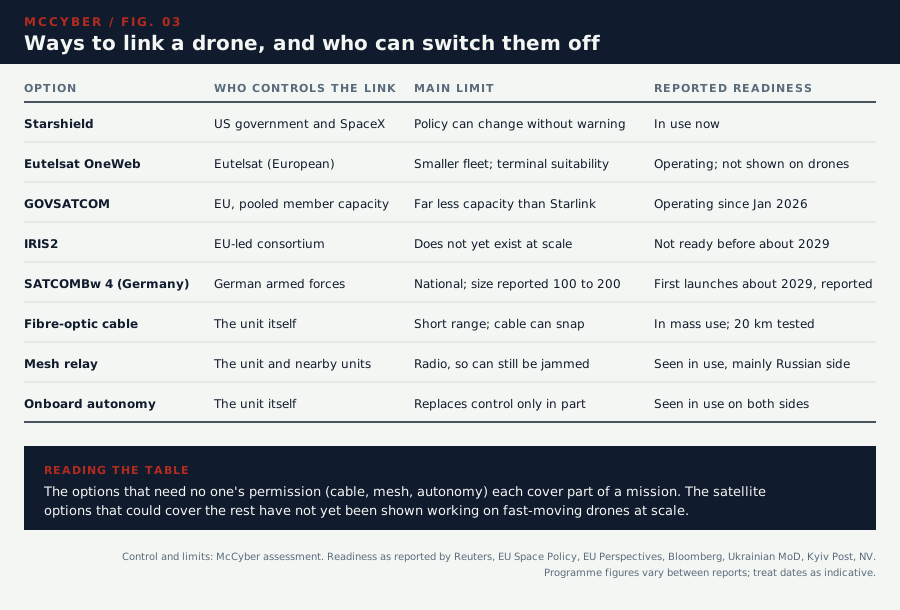
None yet replaces a satellite for long-range, high-speed, live video control.
The strongest objection is that this is a policy dispute dressed as a technology problem. The cap is unexplained, and a restoration within about a day suggests it may be adjustable. One episode does not prove satellites are unreliable; for most missions the link has been transformative, and the same control that throttled Ukrainian drones also cut off Russian ones. Sovereign constellations are slow and expensive, and diversifying to fibre and mesh gives up range and speed. Dependence may be the rational price of capability, so long as it is bounded.
That argument has force, but it misses a distinction: owning a constellation is not the same as being resilient to losing one. Europe could own a constellation whose terminals cannot serve fast drones, while an American service with enforceable access terms and fallback links might serve better. The test for any option is not whose satellites they are, but whether losing one service makes an essential mission impossible.
Sources: Institute for the Study of War; Kyiv Independent; The Record; Business Insider; Reuters; Globe and Mail; Axios; Serhii Sternenko (Telegram and X); Hvylya; EU Space Policy; EU Perspectives; Euronews; Space Intel Report; Bloomberg; Reuters (SATCOMBw 4, via syndication); Defence Connect; Ukrainian Ministry of Defence; Ukrainian News; Kyiv Post; National Security Journal.
Subscribe
McCyber intelligence briefings and structural essays, directly. No institutional spin.