Human control of military AI: safeguard or weak point?
Human judgment is the main safeguard in US military AI, and the thing a fast, jammed battlefield wears away. Pentagon policy requires only…
Palantir says the Pentagon replaced Claude inside Maven with no operational impact. The claim highlights a different dependency: the platform connecting models to military data and workflows.
Enable JavaScript and use a browser with spoken audio support to listen.
Read aloud by your browser. Voice and availability depend on your device.
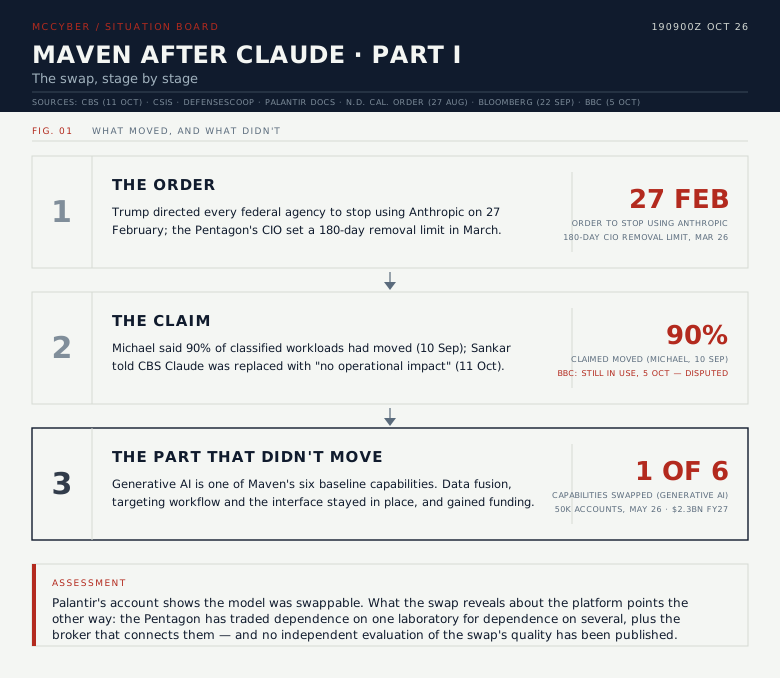
Palantir’s chief technology officer told CBS on 11 October that the Pentagon has already replaced Anthropic’s Claude, and that doing so had no operational impact. Claude was the first frontier AI model deployed on the Pentagon’s classified networks and the language engine behind Maven Smart System, the Palantir-built platform the US military uses to fuse intelligence and find targets, according to CSIS. This essay concerns the platform, not the broader Project Maven programme. Claude’s removal is the first real test of what Palantir has argued since it launched its AI Platform in 2023: that models are interchangeable and the platform is what lasts.
The test is real, but the verdict is narrower than Palantir suggests. On Palantir’s account the model was swappable. What the swap shows about the platform points the other way.
The timeline rests on official statements. According to the California court’s order, President Trump directed every federal agency to stop using Anthropic on 27 February, with a six-month phase-out for agencies such as the Pentagon, and Defense Secretary Pete Hegseth ordered the supply-chain designation the same day. The Pentagon’s chief information officer then set a 180-day removal limit in early March. On 10 September Emil Michael, the Pentagon’s technology chief, told reporters that about 90% of classified AI workloads had moved and that all of the Maven and Palantir work had been transferred months earlier, DefenseScoop reported. Sankar named xAI, OpenAI, Google and Nvidia’s open-weight Nemotron as the replacements, without saying which model does which job.
Vendor and customer share an interest in the story. Michael said Maven’s users preferred newer ChatGPT versions to Claude, yet no comparison of accuracy, speed or error rates has been published. And the BBC reported on 5 October that multiple people familiar with the matter, including former defence officials and contractors, said Claude was still being used the previous week for research, analysis and intelligence work, embedded in Maven. A department official told the BBC it “has ceased the use of Anthropic products”. That statement post-dates both the six-month limit (about 27 August) and the 180-day limit (about 1 September), though DefenseScoop had said the department was targeting October. The BBC’s sources are anonymous and may define “use” differently, so the discrepancy with Michael’s account is unresolved.
Sankar was explicit that Palantir is not among the companies that make AI models, which is why, he said, it was not asked to sign the White House’s AI accord. Palantir does not currently supply the frontier language models on which Maven’s language functions depend. Its documentation lists models from xAI, OpenAI, Anthropic, Meta and Google, and on 15 October it added four more, among them Google’s Gemini 4 Argon, the Chinese laboratory Z.ai’s open-weight GLM-5.3 and Claude Haiku 5.5. Claude is therefore still in the catalogue, for commercial customers and for US government customers at the lower IL2 and IL4 security levels. The exclusion applies to Defense Department work, and the appeals court ruling does not bar Anthropic from government as a whole. The California judge also called the Pentagon “undisputedly free to select the AI vendor of its choice”, and her March preliminary injunction had left it free to move to other providers.
Subscribe
New essays and snapshots, by email, roughly weekly.
Maven is more than a language model. CSIS lists six baseline capabilities from Palantir’s own documentation: battlespace management, target management, planning and execution, computer-vision detections, machine-assisted disclosure and generative AI. Generative AI is one of the six, and replacing its language models does not amount to replacing Maven. The platform fuses feeds from satellites, drones and sensors into one map, recommends and ranks strike assets, and lets an operator order action from the same screen. US Central Command’s 2024 deployment drew on 179 data sources, CSIS reports, citing Katrina Manson’s book on the programme. Bloomberg reported on 22 September that Maven had 50,000 active accounts by May, more than double the year before, and that its upgrades are a joint effort of Palantir, Central Command and the Maven office.
The same source relays an anonymous National Geospatial-Intelligence Agency official’s estimate that computer vision gave a tenfold gain in targeting speed, with language models adding a further fivefold. Nobody outside government can check that figure, but it suggests Claude accelerated an existing system. That system is being entrenched rather than unpicked. In March Deputy Defense Secretary Steve Feinberg ordered Maven made a program of record, and the FY2027 budget request includes $2.3 billion for it and a companion network, CSIS notes. Faster targeting raises a separate question: whether human scrutiny and the ability to trace responsibility can keep pace.
The Pentagon’s own words show the swap was not trivial. In May Michael said it had been “single-threaded” on one AI vendor and that integrating into classified systems was far harder than putting software on a public cloud, as quoted by CSIS from Nextgov. Reuters had earlier reported that Maven contained prompts and workflows built with Claude that would need rebuilding, as relayed by Start Magazine. A difficult migration does not contradict a claim of no operational impact, but it does challenge the idea that models are plug and play. Lauren Kahn of Georgetown’s Center for Security and Emerging Technology told the BBC that the time it took was “indicative that these things are not just plug and play”, and that once models are integrated “it can be painful to remove them”.
Palantir’s account illustrates the value of an architecture: a layer through which multiple approved models can be connected, tested and replaced. That is a strong commercial position, because each new model makes the layer more useful and the laboratories compete inside a market Palantir organises. The Pentagon has traded dependence on one laboratory for dependence on several, plus the broker that connects them.
The sharpest counter-reading comes from the investor Michael Burry, who argued in March that the six-month phase-out showed the stickiness belonged to Claude’s technology, not to Palantir’s wrapper, as reported at the time. It could still be right. If the replacements were weaker, Palantir and the Pentagon would have every reason to say otherwise, and without published evaluations the public cannot tell. A model that is easy to connect is not necessarily easy to replace in quality.
Even so, the evidence supports only a modest claim. On Palantir’s and the Pentagon’s account, Maven’s language models were replaced without operational disruption, while the data fusion, targeting workflow and user interface stayed in place and gained funding. Without published evaluations, the quality of that substitution remains untested.
On the Pentagon’s account, it has solved one problem: it has removed its exposure to a single laboratory’s usage policy, a limit the court record describes as purely contractual. It has done so by routing model selection through a private company’s platform. Who approves, selects and configures the models inside that platform is not public.
The test of platform dependence is still to come: whether another integrator could take over the workflows, permissions, data connections and operational knowledge built around Maven. Nothing public shows it has been tested.
This is Part 1 of 3 in Maven after Claude. Part 2, on the human in the targeting loop, and Part 3, on who controls an AI agent once a model sits inside someone else’s system, follow next weekend.
Disclosure: Anthropic is a named actor in this essay. McCyber uses Anthropic’s Claude models in its editorial workflow, as set out on the About page.
Sources: CBS News (Face the Nation transcript, 11 Oct); CSIS; DefenseScoop; Palantir documentation and announcements; Anthropic PBC v. U.S. Department of War (N.D. Cal., 27 Aug 2026); Bloomberg (Katrina Manson, 22 Sep); BBC (Kali Hays and Daniel Bush, 5 Oct); Reuters (as relayed by Start Magazine and Yahoo News); Associated Press; Nextgov (as quoted by CSIS); Michael Burry (as reported by Finviz).
Subscribe
McCyber intelligence briefings and structural essays, directly. No institutional spin.