VasyGrek arrests: how Russia polices its own hackers
The VasyGrek case fits a pattern in which the line Russia draws around cybercrime runs through the victim, not the crime. A rare arrest…
American campaigns have adopted generative AI faster than almost any tool in modern politics. Laboratory experiments show it can persuade attentive voters, while decades of field research suggest that campaign contact rarely produces measurable changes in candidate choice. The midterms will be read as a verdict on AI, though they were not designed to deliver one.
Enable JavaScript and use a browser with spoken audio support to listen.
Read aloud by your browser. Voice and availability depend on your device.
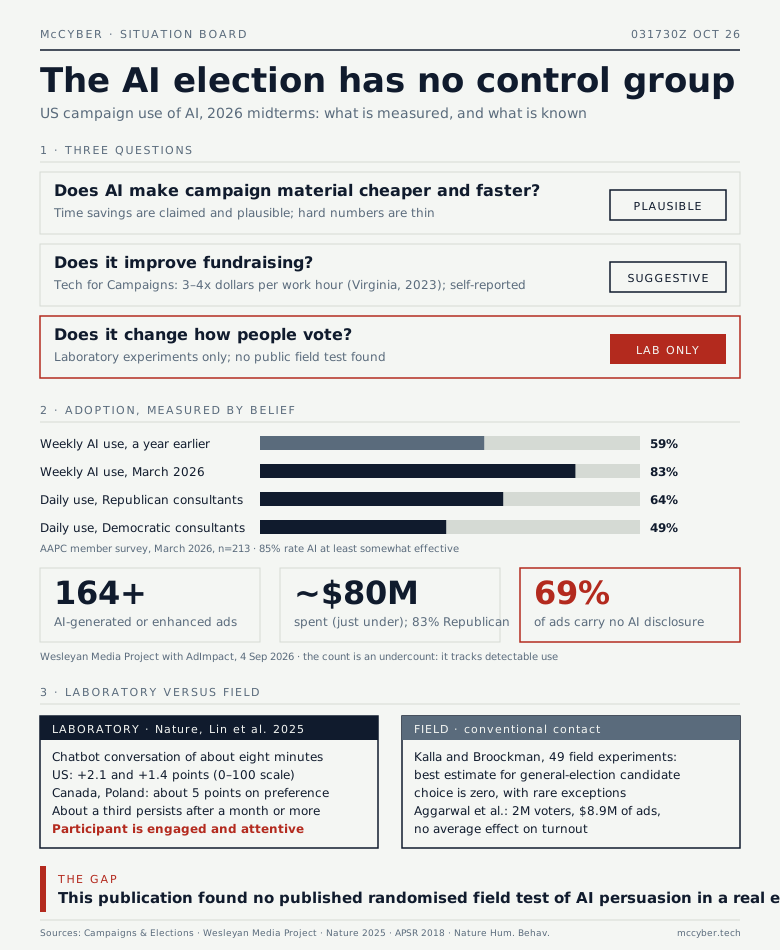
In March, 213 members of the American Association of Political Consultants were asked about artificial intelligence. Eighty-three per cent said they used it at least weekly, up from 59 per cent a year earlier, and 85 per cent called it at least somewhat effective. The survey measures how fast a technology has spread through a profession. It says almost nothing about whether the technology wins votes, because the people answering were rating their own tools. Nobody measured what voters did.
“Does AI work in campaigns?” bundles three questions. Whether AI makes campaign material cheaper and faster to produce has plausible answers, thinly documented. Whether it improves fundraising has suggestive answers, largely from interested parties. Whether it changes how people vote has answers only from laboratory experiments. Adoption has run far ahead of the third.
Uptake is not in doubt. In the same survey, 48 per cent of consultants used AI several times a day, with daily use higher among Republicans (64 per cent) than Democrats (49 per cent). Axios reported in April that the Democratic National Committee had barred staff from using some commercial chatbots while permitting others, and that the National Republican Senatorial Committee was using AI to make ads, analyse data and find small donors.
Client appetite is more guarded than the headline suggests. Fifty-six per cent of consultants said clients asked about their use of AI, but among those asked, only 8 per cent said most clients pushed for it. A plausible reading, which the survey does not establish, is that campaigns adopt AI because the people they hire already have.
The most visible use is advertising. The Wesleyan Media Project identified at least 164 AI-generated or AI-enhanced ads by early September, with spending of just under $80 million. Eighty per cent of the ads and 83 per cent of the spending were Republican-aligned, and 69 per cent carried no disclosure. The project calls its figures an undercount. At the end of May the figure was $19.7 million, so the increase may reflect both more AI advertising and better detection. The tracker counts detectable use, which is narrower than effective use.
The best-documented benefit is time. Tech for Campaigns, a Democratic-aligned group, ran experiments in Virginia in 2023 and reported that AI-aided fundraising emails raised three to four times more money per hour of work, with a human reviewing every draft. It has since claimed a one-third cut in drafting time. These are plausible claims, and they come from an organisation that promotes the tools. For a campaign, saving time is reason enough to adopt, and it requires no claim about persuasion.
The most rigorous persuasion evidence is a Nature study that randomly assigned participants to conversations with a chatbot advocating for one candidate in the 2024 US, 2025 Canadian and 2025 Polish elections. It found effects on candidate preference larger than those typically seen from video advertising. The chatbots persuaded mainly by piling up facts and evidence, and the models advocating for right-leaning candidates made more inaccurate claims.
The conditions of the experiment matter as much as the size of the effect. In the supplementary tables, roughly eight-minute US conversations raised the stated likelihood of voting for the advocated candidate by about 2.1 points for the pro-Harris model and 1.4 points for the pro-Trump model on a 100-point scale. In Canada and Poland, candidate preference moved by about five points. Each came from an engaged participant in sustained conversation with an AI advocate. About a third of the effect remained after more than a month, or about a quarter under the authors’ most conservative assumption, though a direct comparison of the groups at follow-up was not significant for candidate preference.
Subscribe
New essays and snapshots, by email, roughly weekly.
Campaign persuasion has a long record of disappointing. Joshua Kalla and David Broockman’s meta-analysis of field experiments found that the best estimate of the effect of campaign contact and advertising on candidate choice in general elections is zero, with rare exceptions. The difficulty extends to behavioural effects: a later experiment covering two million voters and $8.9 million of digital advertising in 2020 found no average effect on turnout.
Conversational AI could address a historic weakness of campaign communication, which is that mass messaging is one-way. But the experiments give the campaign something real campaigns lack, which is the voter’s attention. A participant has agreed to talk, stays for the whole conversation and faces no competing demands. A voter in October is contacted by dozens of campaigns and can ignore a text in a second. No one has tested this, and it is an analytical judgement, but it suggests where the scarce resource lies. Campaigns may now have a persuasion technology before they have a supply of attention to use it on.
The important missing piece is a published randomised field test of AI-driven persuasion in a real election. This publication could not find one.
Wesleyan’s numbers are observational. They count the ads made with AI and say nothing about what those ads did. AI use is not randomly assigned: it clusters by party, by resources and by how competitive a race is, which are the same factors that decide results. When the votes are counted, candidates who used AI will have won and lost, and each side will credit or blame the technology according to its prior view. Nathan Sanders and Bruce Schneier have observed that the most consequential uses of AI in the midterms may not be known until 2027 or later.
The strongest counter-reading is that none of this matters for the decision to adopt. If AI cuts drafting time by a third, it pays for itself without persuading anyone, and campaigns that skip it will be outworked. Kalla and Broockman also studied a world of mail, canvassing and conventional advertising. If campaigns find a scalable channel through which voters choose to engage with AI agents, that literature may become much less informative. Campaigns also run randomised tests that are rarely published, so the lack of public evidence does not prove that no one holds any. These points are fair, and they support a narrower claim than the adoption figures imply: AI is established as a way to produce more campaign activity, can persuade attentive voters in the laboratory, and has almost no public evidence linking the two.
November will produce an enormous volume of AI-generated campaigning and almost no experiment from which outsiders can infer causation. The country will probably learn who won without learning whether AI won anyone over. A campaign that held back a randomised group from AI-assisted contact and published the result would teach more than the whole tracker of detected ads. If nobody does, the next election will begin much as this one did, with a fast-spreading technology and strong opinions about it but little evidence from the field.
Sources: Campaigns & Elections (reporting on the AAPC 2026 member survey); Axios; Wesleyan Media Project with AdImpact; NBC News; Nature (Lin et al., 2025) and supplementary information; American Political Science Review (Kalla and Broockman); Nature Human Behaviour (Aggarwal et al.); Schneier on Security (Sanders and Schneier).
Subscribe
McCyber intelligence briefings and structural essays, directly. No institutional spin.