VasyGrek arrests: how Russia polices its own hackers
The VasyGrek case fits a pattern in which the line Russia draws around cybercrime runs through the victim, not the crime. A rare arrest…
The Pentagon says it will livestream a military execution on 3 December, but has not said where. The companies that spent a decade removing execution videos from their platforms may refuse to carry it, and the US government may discover how little of the pipeline between camera and audience it actually controls.
Enable JavaScript and use a browser with spoken audio support to listen.
Read aloud by your browser. Voice and availability depend on your device.
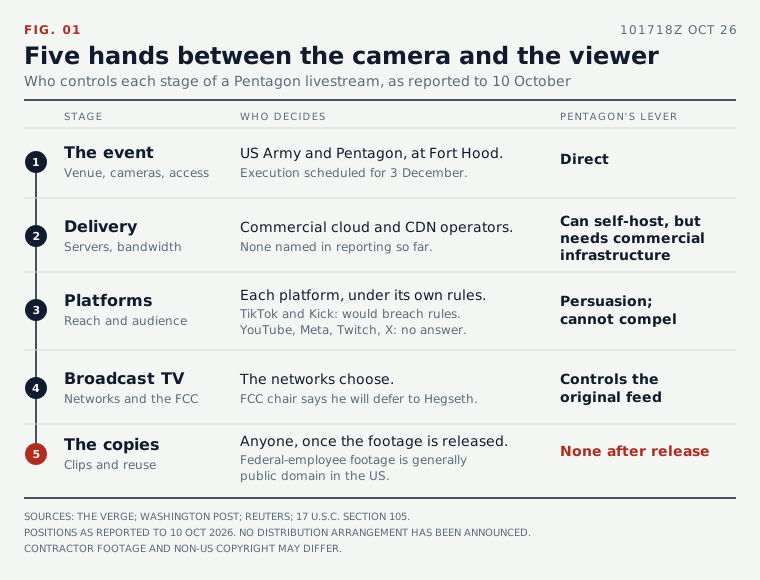
The Pentagon has said it will livestream a firing-squad execution on 3 December. It has not said where. When The Verge asked the major video platforms whether they would carry it, only two replied: TikTok and Kick, a service built on a reputation for light moderation, both said that streaming an execution would break their rules. YouTube, Meta, Twitch and X did not answer.
That silence is the story. The Pentagon plainly has the power to carry out a sentence. What it may not have is the power to put the result in front of an audience, because between a camera at Fort Hood and a viewer’s phone sit companies whose terms of service were written, in large part, to stop this kind of video spreading.
The condemned man is Nidal Hasan, the former Army psychiatrist who killed 13 people at Fort Hood, Texas, in 2009. President Trump approved a firing-squad execution on the recommendation of Defence Secretary Pete Hegseth, who told Real America’s Voice: “We’ll make sure that people are able to watch it, that it’s public.” An anonymous Pentagon official then told Reuters that details would follow. Hegseth had not said how the public would watch.
By Friday the plan looked less settled, and the president’s own signals were mixed. Trump said a determination on the stream was still to be made, yet when asked whether he had approved it, answered “Absolutely”. Vice President JD Vance said he did not know it would happen and that, if it did, he would not be watching. Hasan could also seek review in a civilian court, which military-law experts told the Associated Press could significantly delay the execution. This is therefore an essay about a confrontation that may never happen. If it does, it will be the first US military execution since 1961, and Reuters called a livestream “an unprecedented move”.
Putting a killing on display as a lesson to the public is an indefensible idea, and the objections so far have come from both parties. The technology question underneath it is separate, and more revealing.
A social platform decides whether to publish and promote a video. A hosting or delivery company decides whether to carry the data at all. The distinction matters because the Pentagon does not strictly need YouTube. It could embed a player on an official website and buy the capacity to deliver it from a commercial content delivery network, the layer of servers that lets millions of people watch the same stream at once. Amazon Web Services, Cloudflare and Akamai are the kind of company that sells this. Nothing in the reporting so far suggests any of them has been approached; they illustrate the architecture rather than name contractors.
The platforms’ own rules lean one way, though not equally. Meta’s Community Standards bar livestreams of capital punishment, and the Washington Post reports that it has done so since 2019. Twitch’s guidelines bar content showing death or extreme injury and list no news or government exception. X is less clear: it allows labelled graphic media, with public-interest and newsworthiness exceptions, and its violent content policy does not mention executions. YouTube’s firearms policy bars livestreams of anyone handling a firearm, which describes a firing squad rather neatly, but it also lists public-interest exceptions that include military footage and debate over government action. Whether an official execution would qualify is exactly what YouTube has not said. None of the companies has said whether it would make an exception for a government. That is the real test. Refusing an anonymous uploader costs nothing. Refusing a government that is a major customer and a potential regulator is a different decision.
Further down the stack the same logic repeats with less visibility. A cloud or delivery provider has acceptable-use terms of its own, and is rarely asked to apply them to a department of state. If every consumer platform declined and the Pentagon hosted the stream itself, the question would move to the companies most people never think about: who supplies the servers, the video encoding and the bandwidth, and whether they would accept being named.
Subscribe
New essays and snapshots, by email, roughly weekly.
Controlling the camera is not the same as controlling the copies. Under Section 105 of the US copyright statute, works prepared by federal employees as part of their official duties receive no US copyright protection, and the legislative history says the intent is to place such works in the public domain. Footage shot by serving personnel on duty would ordinarily fall into that category. There are complications, including contractors, third-party material and protection abroad, since the same history says the prohibition is not meant to affect foreign copyright. The practical consequence is that a network, a foreign broadcaster or anyone with a screen recorder could reuse the footage without asking. Platform rules and other laws would still apply, but copyright would not be the state’s lever.
This is the risk that Jack Reed, the senior Democrat on the Senate Armed Services Committee, identified when he called the plan a gift to anti-American terrorist recruiters. The same logic applies to hostile states, which could select clips to support narratives about American violence. That is a foreseeable distribution risk, not a prediction that any particular actor will do it. The Pentagon would control the beginning of the process and none of the end. Platforms would control something subtler: how the footage is presented. YouTube could refuse the live stream yet allow news organisations to upload extracts under its public-interest exceptions. That would look inconsistent, but there is a coherent line between broadcasting a death as it happens and reporting on an event that has occurred.
The comparison with ISIL is tempting and needs care. ISIL murdered hostages and civilians as terror and propaganda. Hasan’s execution would follow a conviction and sentence under a recognised military process. Those are different acts, and no reading of the comparison should blur them.
But a moderation system does not read legal status. It reads video, and context. The machinery that platforms now use to find and remove execution footage was built, in part, in the fight against ISIL’s online operation. Brookings researchers estimated that at least 46,000 Twitter accounts were used by ISIS supporters between September and December 2014, that a small core of between 500 and 2,000 hyperactive accounts drove much of the reach, and that Twitter suspended at least 1,000 of them in that period. Governments spent years demanding that companies get faster at removal. Moderation is contextual, and platforms already distinguish journalism and documentary from material that glorifies violence. The narrower question is whether a government’s identity should automatically exempt its own material from rules written to stop graphic violence spreading.
What the two cases share is the communicative logic: a killing shown to a remote audience is a message, and Hegseth’s stated purpose is that people should understand the consequences of serious crimes. What differs is who stands between the film-maker and the audience. ISIL had to evade the platforms. The Pentagon has to persuade them, or go round them.
The tidy version of this story is that Silicon Valley has more scruples than Washington and may be about to prove it has more power too. It is incomplete in three ways.
First, silence is not refusal. YouTube, Meta, Twitch and X have said nothing, and platform behaviour under political pressure has been mixed. The FCC regulates broadcasters rather than internet platforms, but its chairman, Brendan Carr, has deferred to the Pentagon on whether television networks may air the execution, having earlier threatened broadcasters’ licences over coverage of the Iran war. The state has leverage over parts of the media, and the companies deciding this will be weighing contracts and regulation as well as principle.
Second, platform rules reflect liability and brand risk as much as ethics, and they are applied unevenly. After a bishop was stabbed during a livestreamed church service in Australia in 2024, X resisted government demands to remove the footage globally. A company that resists one government’s takedown demand is not exercising a clean moral veto, and may not apply the same test to the next.
Third, the first public objections to this plan did not come from a platform. They came from elected politicians in both parties, which is how a democracy is supposed to work, although so far there is no evidence that they have changed the plan. A private veto, however welcome in this case, is not accountable in that way: the discretion that blocks an execution video can block other things, for reasons the public cannot contest. And the veto is narrow. It governs reach, not existence. The Pentagon can still stream from its own servers.
For years, governments demanded that technology companies stop execution videos spreading online. Now the American government may ask them to carry one. If the companies refuse, the decisive act in a state execution will have been taken by a trust-and-safety team. If they agree, it will have been taken there too. They may find they have both the freedom to say no and the power to make it count, or that their standards bend as readily as anyone’s. Nobody yet knows which.
Sources: Associated Press (via PBS NewsHour), Reuters, States Newsroom, Washington Post (via the Spokesman-Review), The New Daily, CBS News, Axios, The Hill, The Verge (as summarised by secondary outlets), NPR, YouTube Help, Brookings Institution, US Code (Cornell Legal Information Institute).
Subscribe
McCyber intelligence briefings and structural essays, directly. No institutional spin.