Silver Fox: China says it has arrested 63 malware suspects
China's Ministry of Public Security says it has put 63 people under criminal compulsory measures over Silver Fox, a Chinese-language…
In six months India bought record Russian oil, signed a landmark trade deal with Europe, thawed with China, and quietly defied Washington. Is multi-alignment a strategy — or a stress position?
Enable JavaScript and use a browser with spoken audio support to listen.
Read aloud by your browser. Voice and availability depend on your device.
In June 2026, India imported somewhere between 2.6 and 2.7 million barrels per day of Russian crude, depending on whose vessel-tracking count you take — a record by any of them. Russia supplied more than half of India’s total crude imports for the month. The US sanctions waiver that had temporarily protected purchases involving sanctioned Russian cargoes expired on 17 June without Washington announcing enforcement action — or, for that matter, clarifying whether sanctions had snapped back at all.
That quiet non-confrontation is the most revealing data point of the year, because four months earlier the White House had announced a trade deal with India that, in Washington’s telling, rested on New Delhi stopping those very purchases. Trump’s executive order removing his punitive tariff stated flatly that India had “committed to stop directly or indirectly importing Russian Federation oil” — and threatened additional action if imports resumed. The joint statement India actually signed said no such thing, and Indian officials have never confirmed the commitment. Two governments, one deal, two incompatible accounts of what was agreed — and a tanker fleet quietly settling the argument in Russia’s favour.
Welcome to the most ambitious balancing act in world politics. In the first half of 2026, India bought record volumes of oil from Russia, concluded a landmark trade agreement with Europe, pursued a cautious thaw with China, and pocketed tariff relief from an American administration whose version of the bargain it declines to endorse. Every great power gets something from India; none gets exclusivity. The question this piece asks is whether that is a durable strategy for a rising power — or a tightrope act that works only until one of the anchors pulls.
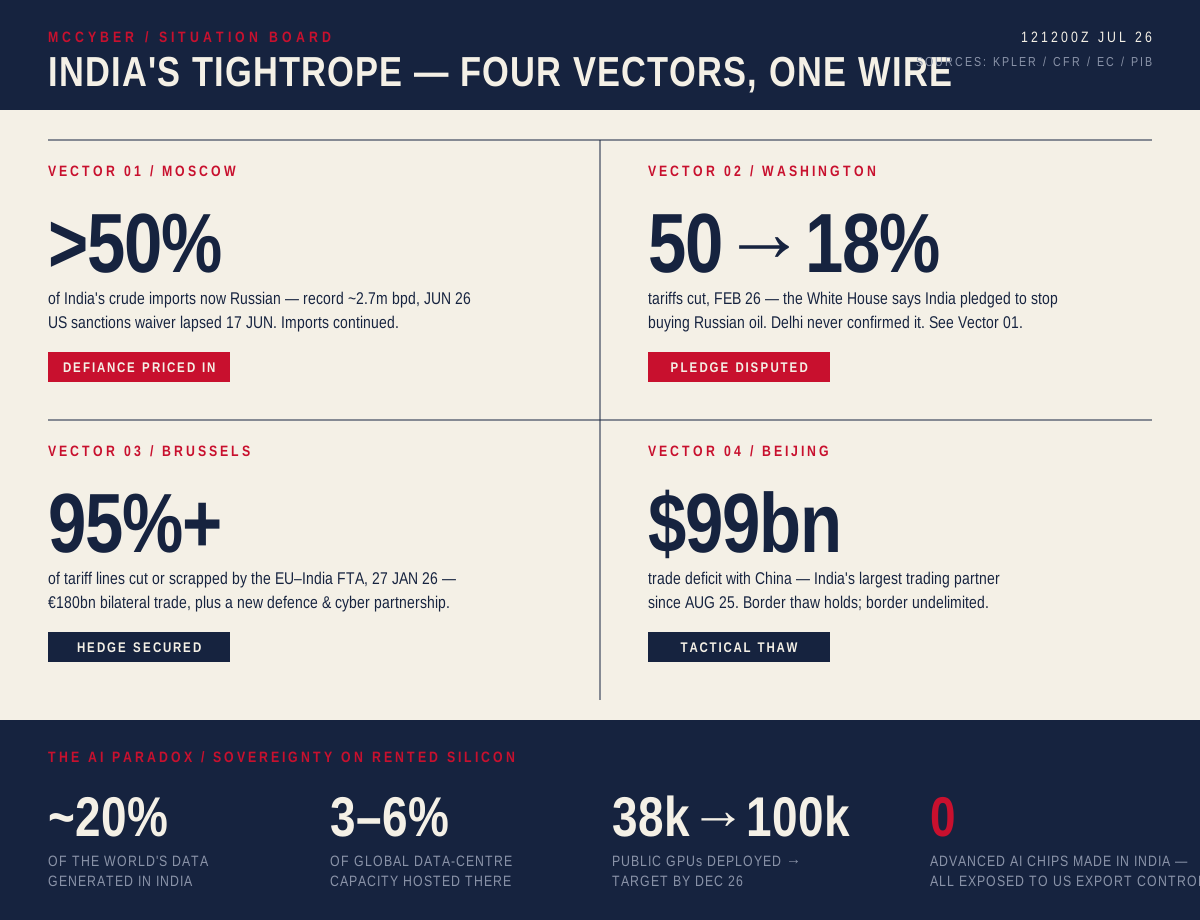
The Russia relationship survived the strongest pressure campaign Washington has ever mounted against a partner. In August 2025, the Trump administration imposed a 25 per cent punitive tariff on Indian goods over Russian oil purchases — stacked on top of an earlier 25 per cent trade tariff, for a combined 50 per cent that put India in the same bracket as Brazil and froze a quarter-century of warming ties. The objection was not arbitrary caprice, whatever Delhi’s talking points implied: every discounted barrel helps fund Moscow’s war in Ukraine, and choking that revenue is the stated point of the entire Western sanctions architecture. India’s counter — that it stabilised global prices by absorbing barrels the West wouldn’t touch, while Europe kept buying Russian goods of its own — is also not nothing. Both things are true at once, which is why the argument never resolves.
And the pressure briefly worked. By December 2025, India’s Russian imports had fallen to a 38-month low while American oil purchases rose 31 per cent year on year. Then geography voted. The Strait of Hormuz — the transit route for roughly 40 per cent of India’s crude — was disrupted from late February 2026, taking Iraqi supply effectively to zero for months. Indian refiners turned back to the one supplier with spare volume, a renewed discount, and — critically — four years of purpose-built plumbing: rupee, ruble and dirham payment rails, reconfigured refineries, established shipping. The infrastructure of sanctions-proofing, once built, does not un-build itself.
The lesson is uncomfortable for anyone who believes economic coercion disciplines middle powers. Washington’s pressure changed India’s behaviour for exactly as long as the alternative supply existed. The moment it didn’t, national interest reasserted itself — and the United States, needing India too much to punish it, absorbed the defiance.
The China relationship tells a subtler story. The thaw began with the October 2024 border agreement on patrolling arrangements at Depsang and Demchok — before Trump’s tariffs, and driven by both countries’ own calculations, not least Delhi’s recognition that its manufacturing ambitions run through Chinese supply chains. What Washington’s subsequent pressure did was accelerate it. Tariffed by the same administration and exposed to the same energy shocks, Beijing and New Delhi found fresh reasons to want a quieter Himalaya: resumed direct flights, reopened border trade passes, delimitation talks on the border and trans-border rivers, and — expected in September — Xi Jinping’s first visit to India in years, timed to the BRICS summit in New Delhi.
But call it what it is: tactical stabilisation, not reconciliation. The border remains undelimited across 3,500 kilometres. China’s trilateral initiatives with Pakistan, Bangladesh and Afghanistan ring India’s neighbourhood. And the economic relationship is profoundly lopsided — China overtook the United States as India’s largest trading partner in August 2025, while India’s trade deficit with Beijing swelled to $99 billion in FY 2024–25. That deficit is not only a China problem; it is an indictment of two decades of Indian industrial policy that has yet to build the domestic component base its manufacturing rhetoric assumes. India needs Chinese inputs to become the power that would reduce its dependence on China. That circularity is the thaw’s engine and its ceiling.
Subscribe
New essays and snapshots, by email, roughly weekly.
Then came Europe. On 27 January 2026, after nearly two decades of stalled negotiation, India and the EU concluded their free trade agreement — “the mother of all deals,” in Ursula von der Leyen’s phrase. The numbers justify some of the hyperbole: two economies covering a quarter of the world’s population and GDP, roughly €180 billion in existing bilateral trade, tariffs eliminated or reduced on goods representing 96.6 per cent of EU exports to India, and a stated ambition to double EU exports to India by 2032. Whether it is India’s “largest ever” trade deal depends on the yardstick; that it is among the most consequential is hard to dispute.
The more telling detail is what came stapled to it: a security and defence partnership spanning maritime security, cyber resilience, counterterrorism and defence-industrial collaboration — a framework designed, in part, to wean India off Russian arms. Brussels and New Delhi barely disguised the geopolitical logic. A deal that spent twenty years dying of dairy tariffs and whisky duties was resurrected in months by a shared fear: overdependence on an America that tariffs its friends and a China that leverages its supply chains. The symbolism was laid on thick — von der Leyen and António Costa as principal guests at Republic Day, the week the deal closed.
For India, Europe is the perfect hedge: economically enormous, strategically unthreatening, and demanding nothing India cannot give. Except one thing — distance from Moscow. The FTA’s fine print defers that argument; it does not resolve it.
Which brings us back to Washington, and the strangest deal of the year. The February framework dropped US tariffs from 50 to 18 per cent and even includes language protecting India’s access to advanced American AI chips. In exchange, per the White House, India committed to buy $500 billion of American products over five years — and to stop buying Russian oil. Per New Delhi, it committed to the purchases and said nothing about the oil. The gap between those two accounts was never closed; it was papered over, and the paper is now visibly peeling. Private refiners like Reliance did stop buying Russian crude; state refiners did not, and Moscow pointedly noted it had received no notice of termination from the Indian government.
Then the courts intervened. A US Supreme Court ruling against Trump’s tariff regime constrained his ability to wield the 50 per cent stick again, and analysts concluded Washington would not press the oil issue hard and risk its own growing energy exports to India. So the relationship sits in a strange superposition: tariff relief delivered, a pledge asserted by one side and unacknowledged by the other, an enforcement threat the courts have blunted, and a mutual decision not to force the issue. It is the purest expression of the new bilateral reality — transactional, unsentimental, and governed less by what was signed than by what each side can currently get away with.
India’s AI story is where the geopolitical pattern repeats at the level of technology — and where it gets genuinely interesting for anyone thinking about power in this century.
New Delhi is not trying to win the frontier race. It is running a different play: sovereign AI for a billion-plus users in 22 languages. The $1.25 billion IndiaAI Mission has stood up a shared national compute pool — some 34,000–38,000 subsidised GPUs today, targeting 100,000 by December — and its flagship bet delivered this spring when Sarvam AI unveiled two foundation models, a 30B and a 105B, trained on Indian compute and open-sourced in early March. Sarvam’s own evaluations show them achieving state-of-the-art results on several Indic-language benchmarks and competing credibly with far larger international models on Indian-language tasks — a genuine achievement, even if independent verification is thinner and the models trail the frontier on general benchmarks. The AI Impact Summit in February pulled in over $200 billion in announced infrastructure commitments, including roughly $110 billion from Reliance and $100 billion from Adani — though announced is the operative word: these are long-dated corporate pledges, not deployed capital.
Measured against the ambition of most middle powers, this is a serious, coherent programme. Measured against the rhetoric of sovereignty, it rests on foundations India does not control. Much of the country’s most advanced AI compute depends on NVIDIA and other foreign-designed accelerators, all of it exposed to US export-control policy — the same Commerce Department machinery that severed China from advanced chips could, in a different political season, be pointed at India. The trade framework’s chip-access guarantee is reassurance written on paper by an administration that has already tariffed India twice.
And there is a deeper asymmetry. India generates by common estimate around a fifth of the world’s data — a figure to treat as directional rather than precise — and hosts perhaps 3–6 per cent of its data-centre capacity. Data-rich, compute-poor. Indian experts put it more bluntly: fifty thousand H100s will not save you if your training corpus is thin — and the country still lacks the frontier researchers to close the architectural gap. India is building the middle of the AI stack, at scale and with real skill, on a foundation designed elsewhere.
Strip away the summitry and one thesis emerges: India is betting that in a fragmenting world, the power that commits to no one holds leverage over everyone. Six months of evidence says the bet is paying — record Russian oil and a European mega-deal and a Himalayan thaw and American tariff relief, simultaneously, with no relationship actually severed.
There is a reading of all this as pure strength, and it deserves stating fairly: India is not scrambling between suitors, it is being courted by all of them, and a country that can extract a trade deal from Washington while defying Washington’s central demand is winning, not wobbling. On this view the tightrope metaphor flatters the anchors and undersells the walker.
But every position in the portfolio carries the same latent risk: each partner tolerates India’s hedging only while it needs India more than it resents the hedge. The EU wants distance from Moscow that Delhi won’t give. Washington’s version of the February bargain includes a pledge Delhi has never acknowledged and visibly isn’t keeping. Beijing’s thaw coexists with a $99 billion imbalance and an undelimited border. And the AI programme’s foreign silicon dependency sits one policy turn away from becoming leverage in someone else’s hands.
Multi-alignment is not a doctrine of independence. It is a doctrine of managed dependencies — and it works precisely until two of them make the same demand at the same time. In 2026, India walked the tightrope brilliantly. The interesting question is not whether it can balance, but what happens when the wire starts to move.
Subscribe
McCyber intelligence briefings and structural essays, directly. No institutional spin.