Silver Fox: China says it has arrested 63 malware suspects
China's Ministry of Public Security says it has put 63 people under criminal compulsory measures over Silver Fox, a Chinese-language…
The MAGA online ecosystem is usually described as a media empire. It is better understood as a merger of three trust networks — partisan media, charismatic Christianity, and armed fraternity — and its resilience comes from that redundancy. What happens when the legal deterrent aimed at one of those networks is switched off?
Enable JavaScript and use a browser with spoken audio support to listen.
Read aloud by your browser. Voice and availability depend on your device.
On Friday, a federal judge dismissed the remnants of the US government’s landmark seditious conspiracy case against the Proud Boys — five and a half years after the Capitol attack, and months after the Justice Department itself asked the courts to erase the convictions of the militia leaders it had once prosecuted. US District Judge Timothy Kelly, a Trump appointee, was at pains to note that his ruling was no endorsement of the government’s decision to abandon the case; the separation of powers left him little choice. The most serious criminal judgments ever secured against America’s paramilitary right are being unwound in real time. To understand why that matters beyond the courtroom, you have to understand what those groups are part of: not a fringe, but one wing of an unusually resilient online ecosystem.
The American right’s information environment is best read as concentric layers rather than a single bloc. At the centre sits legacy conservative media — Fox News, talk radio — still the agenda-setters for older audiences. Around them orbit digital-native outlets built for the social platform era, their business models tuned to engagement. The third layer, now arguably the most influential, is the creator economy: podcasters, streamers, and X personalities whose audiences rival cable news and whose power rests on parasocial trust — followers experience hosts as friends, so claims feel vetted by relationship rather than by editorial process. A fourth layer of alt-tech platforms — Rumble, Truth Social, Gab, Telegram — grew out of moderation disputes with the mainstream platforms. At the periphery sit anonymous forums where the most extreme content originates and from which memes migrate inward, laundered of their provenance at each step.
What makes this network distinctive is its insularity. Research by Yochai Benkler, Robert Faris, and Hal Roberts at Harvard’s Berkman Klein Center — published as Network Propaganda — found that right-wing media form a self-referential cluster largely detached from traditional journalistic institutions, weakening the correction mechanisms that normally slow a false claim down. But a map of outlets and platforms misses two structures that give the MAGA ecosystem its social depth: the pulpit and the militia. What follows is an analytical frame built from documented overlaps between the three, not a finding established by any single study.
Evangelical Christianity supplies the ecosystem with something no podcast can manufacture: pre-existing, physically rooted communities of high trust. Churches are simultaneously congregations, social networks, and — since the pandemic normalised livestreaming — media operations. Layered on top sits a booming online religious-media economy: Christian broadcasters, worship-adjacent influencers, and, most consequentially for analysts, a charismatic “prophecy” scene in which self-described prophets and apostles interpret political events as episodes in a spiritual war. In that framing, political opponents are not merely wrong but demonic, and contested claims become matters of faith rather than evidence — a structure that is extraordinarily resistant to correction.
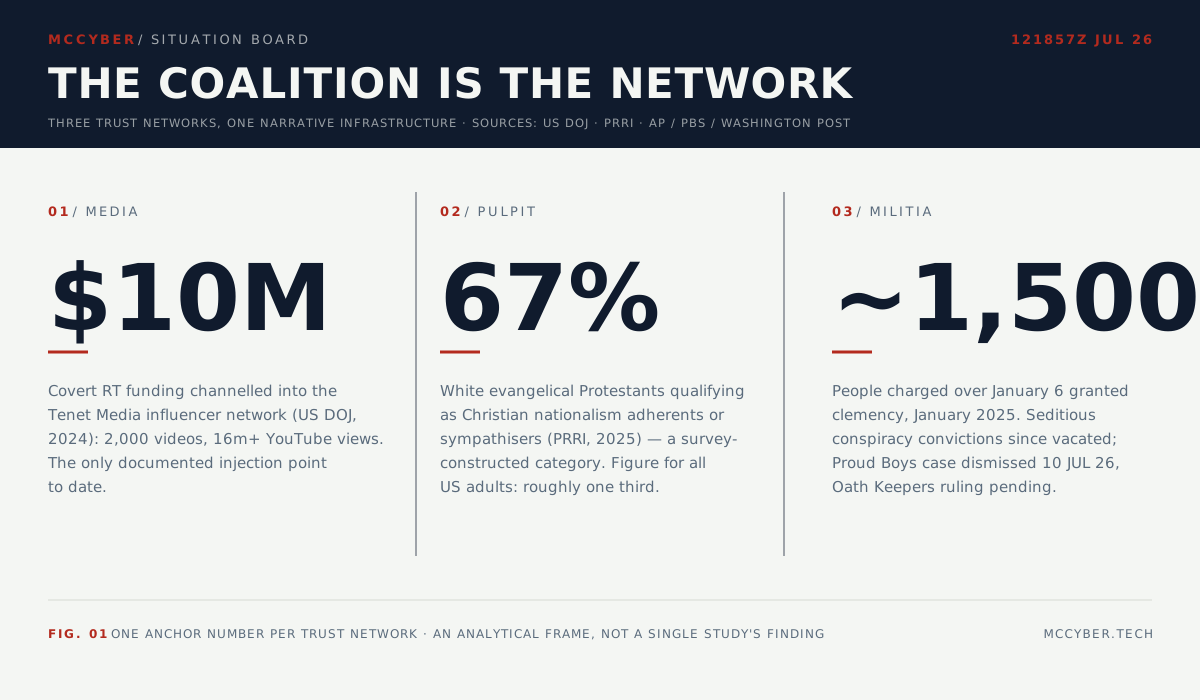
The scale is measurable. PRRI’s 2025 American Values Atlas finds that around a third of Americans qualify as Christian nationalism adherents or sympathisers — a category constructed from survey responses, not a label respondents chose for themselves — but among white evangelical Protestants the figure is 67 per cent — the highest of any major religious group. The same research programme found the outlook correlates strongly with media diet: two-thirds of Americans who most trust far-right television news qualify as adherents or sympathisers. The pulpit layer and the media layers are not adjacent; they are interwoven, sharing audiences, platforms, and increasingly a common narrative in which the nation’s Christian character is under siege and one political movement is its divinely sanctioned defence.
The necessary precision: American evangelicalism is vast, theologically diverse, and mostly consists of ordinary congregations doing ordinary religious life. PRRI’s own data shows a third of white evangelicals reject or are sceptical of Christian nationalism. Religious media is not disinformation, and treating tens of millions of believers as a threat vector would be analytically wrong and strategically self-defeating. The point is narrower: a specific politicised current within evangelical online culture functions as a trust-transfer mechanism, converting religious authority into political certainty at scale.
Subscribe
New essays and snapshots, by email, roughly weekly.
The militia and street-movement wing — the Oath Keepers, the Proud Boys, the Three Percenter tendency — is numerically tiny by comparison, but it performs a different function: it embodies the ecosystem’s narratives physically. These groups recruited heavily among military veterans and former police, organised openly on mainstream platforms until the major purges of 2020 pushed them onto Telegram and alt-tech, and reached their apogee on 6 January 2021, when Oath Keepers stack formations and Proud Boys marching columns moved through a crowd that was also, visibly, praying.
The legal aftermath was the largest investigation in US Justice Department history. Oath Keepers founder Stewart Rhodes drew eighteen years for seditious conspiracy; Proud Boys chairman Enrique Tarrio, twenty-two. Then, on the first day of his second term, President Trump pardoned or commuted the sentences of the roughly 1,500 people charged over January 6; Tarrio was pardoned outright, Rhodes released on commutation. In April this year the Justice Department moved to vacate the seditious conspiracy convictions altogether. Friday’s ruling closed the Proud Boys case for good; the parallel request in the Oath Keepers case is still pending before a different judge. Rhodes, for his part, resumed his media circuit within months of release. For researchers of political violence, the mechanism to watch is not any single group’s membership rolls but the deterrence signal: the ecosystem’s most committed actors have now observed that its most serious criminal consequences can be politically reversed.
What binds pulpit, militia, and media into one ecosystem is shared narrative infrastructure. The stolen-election claim was perhaps the clearest fusion event: a story that could be told simultaneously as journalism (in partisan media), as prophecy (in charismatic networks), and as a call to arms (in militia channels), each register reinforcing the others. Travelling revival-style political events, cross-posted influencer content, and shared platforms keep the circuits connected between crises.
That redundancy may also make the network particularly attractive to hostile foreign actors, who do not need to build an audience — only to inject content into an existing pipeline. The clearest documented case remains Tenet Media: in September 2024 the US Department of Justice indicted two employees of Russia’s RT for covertly channelling nearly $10 million into a Tennessee company that paid prominent right-wing influencers, whose videos drew more than 16 million views on YouTube alone. The influencers were not accused of wrongdoing — most were apparently unwitting, which is the point. An authentic domestic voice with a trusting audience is cheaper, more credible, and more durable than any troll farm. A network with three overlapping trust systems offers, in principle, three separate injection points — though it should be said plainly that only one, influencer media, has so far been documented.
The strongest objection to this frame is that it overstates coherence. These constituencies are fractious and often mutually contemptuous: secular nationalist influencers mock the prophecy scene, militia veterans distrust media personalities they consider grifters, and the movement’s online spaces are riven by feuds. Researchers who tracked the militia milieu after January 6 documented organisational collapse and membership flight under prosecution pressure, and most evangelical political engagement remains conventional — voting, lobbying, ordinary civic life. On this reading, “ecosystem” imposes a conspiratorial shape on what is mostly the ordinary sociology of a large political coalition, and left-leaning media spaces exhibit their own insularity, even if the research consensus finds the pattern less pronounced. Nor are such networks irrepressible: research on deplatforming has repeatedly found that removing extremist influencers from major platforms sharply cuts their reach. The rebuttal is that the frame describes infrastructure, not coordination: nobody needs to direct a network whose incentives already align.
Which returns us to Friday’s courtroom. The narrative infrastructure survived four years of prosecutions intact; now the legal deterrent created by the January 6 prosecutions has been largely dismantled by the very government that built it. The American information environment has run many experiments since 2016, but this one is new: a fused media–faith–militia network, battle-tested, its media wing demonstrably penetrated by a foreign state at least once, and newly assured that the cost of its most extreme expression can be waived. The question for the years ahead is not whether the ecosystem endures — it will — but what its most committed nodes conclude they can now afford.
Sources: US Department of Justice; The Washington Post/AP; NPR; PBS NewsHour/AP; PRRI (2024 and 2025 American Values Atlas); Benkler, Faris and Roberts, “Network Propaganda” (Oxford University Press, 2018).
Subscribe
McCyber intelligence briefings and structural essays, directly. No institutional spin.