Silver Fox: China says it has arrested 63 malware suspects
China's Ministry of Public Security says it has put 63 people under criminal compulsory measures over Silver Fox, a Chinese-language…
The American Bill of Rights was written for a world of muskets, town squares and letters kept in a locked drawer. Two and a half centuries of invention have moved much of private life and public speech into places the framers never pictured. The question is whether the amendments have lost their grip on modern life, or whether their broad wording is exactly what allows them to keep up.
Enable JavaScript and use a browser with spoken audio support to listen.
Read aloud by your browser. Voice and availability depend on your device.
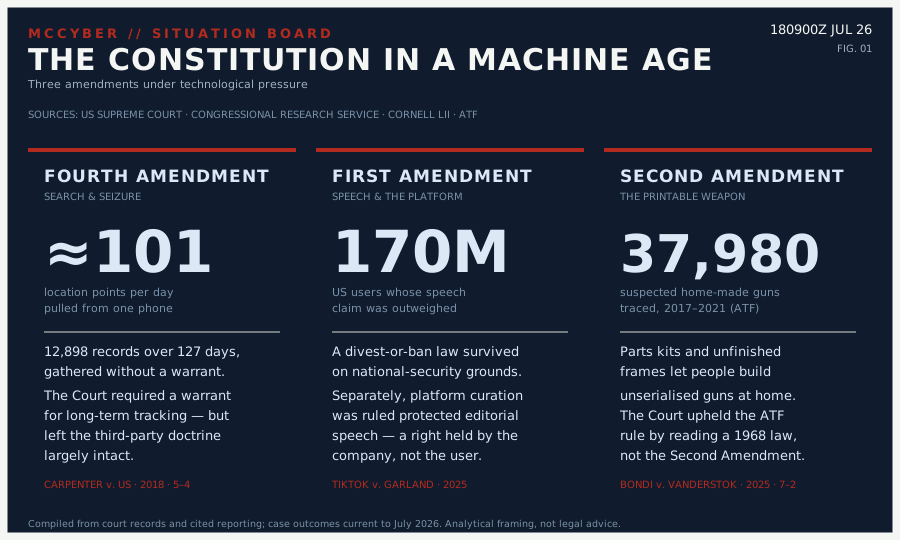
Over 127 days, federal investigators built up 12,898 records of where Timothy Carpenter’s phone had been — about 101 a day — and the lower courts first said they could gather all of it without a warrant, under the existing rules for records that a company holds about you. In 2018, in Carpenter v. United States, the Supreme Court disagreed, deciding that a map this detailed of a person’s movements counted as a search, and so generally required a warrant.
The framers who wrote the Fourth Amendment were reacting to British soldiers turning over people’s homes under open-ended warrants that named nothing in particular. They protected “persons, houses, papers, and effects” — the things you owned and kept close. They had no way to picture a trail of papers and effects that you produce automatically, every waking minute, and hand straight to a private company without thinking about it.
That gap sits at the heart of an old argument about whether the constitution’s amendments still do their job. One view is that the information revolution has quietly hollowed them out. The other is that the wording was left broad on purpose, so it could travel across exactly this kind of change. Both have a fair amount of evidence behind them, which is why neither of the confident answers is quite right.
The case for erosion starts with the Fourth Amendment and a rule the courts invented that the framers never wrote down. Once you hand information to someone else — your bank, your phone company — it loses much of its protection, because you’ve already shared it. Lawyers call this the third-party doctrine. In 1791, far less of an ordinary person’s private life was continuously recorded and kept by third parties. Today almost all of it is: where you go, what you search for, what you buy, who you message at 2am, how well you slept. A right built around your house and your sealed post struggles when the sensitive material lives on a server you’ve never seen and is created without you doing anything at all.
Carpenter made a narrow exception for long-term location data, then went out of its way to leave the wider rule in place, so most of the data economy still sits outside the warrant requirement. The amendment hasn’t been repealed. It has been quietly gone around. The government rarely needs to force its way into your home when it can buy or request the digital trail you leave everywhere anyway.
The First Amendment shows a similar strain from a different direction. It limits the government: “Congress shall make no law.” For most of American history the main threat to free speech really was the state. Now the organisations that decide what billions of people see and post are private platforms, and the amendment was never meant to bind them. When a social network promotes, buries or deletes a post, it usually isn’t breaking anyone’s constitutional rights, because it isn’t the government.
The courts have largely kept that distinction intact. In 2024, in Moody v. NetChoice, the Supreme Court said that at least some of what a platform does — choosing what to carry, how to order it, what to take down — is a kind of protected editorial expression, much like a newspaper deciding what runs on its pages. It sent challenges to social-media laws in Florida and Texas back to the lower courts rather than settling them, while making clear that a government trying to dictate what a feed must contain runs into serious First Amendment trouble.
Six months later, in January 2025, the Court let a very different move stand. In TikTok Inc. v. Garland it upheld a law telling the app’s Chinese owner to sell up or shut down, accepting the government’s national-security argument about foreign control and data collection over the free-speech objections of TikTok’s 170 million American users. So the same amendment now protects a company’s right to arrange its feed in one case and gives way to security concerns in another.
There’s a catch worth sitting with, though. The fact that the First Amendment doesn’t usually bind platforms isn’t only a loophole. Forcing a platform to carry speech it would rather drop, or treating it as though it were the government, would hand the state a say over editorial decisions — which is close to the very thing the First Amendment was built to prevent. Reining in private power over speech and keeping the government out of editorial choices pull in opposite directions, and there’s no clean way to have both.
Subscribe
New essays and snapshots, by email, roughly weekly.
Set against all this is a fair rejoinder: the amendments have kept up before, again and again, precisely because they were written as broad principles rather than rules tied to any one gadget. The Fourth Amendment doesn’t mention letters, phones or servers. It names a value — being secure against unreasonable government intrusion — and the courts have carried that value forward as the technology changed. They applied it to wiretaps and a “reasonable expectation of privacy” in 1967, to a heat-sensing camera pointed at a house in 2001, to the contents of a mobile phone taken during an arrest in 2014, and to long-term location tracking in Carpenter. Each time the machinery changed, the principle stretched to fit.
You can see the same thing in Moody, where the Court reached back to a 1974 ruling about a newspaper’s right to choose what it prints and applied it, more or less unchanged, to an algorithmic feed. On this reading, the breadth of the wording has worked as a feature rather than a fault. The drafters used broad language in places, and that breadth has let later courts read the words onto situations no one in 1791 could have imagined. The amendments aren’t museum pieces. They’re doing the ordinary work of being applied to new facts.
Both of those readings can be true at once, because the real friction sits somewhere the eighteenth-century text barely touches: how slowly the law moves compared with how fast the tools change. The courts adapt, but case by case, over years. The technology moves in months. By the time the law settles around one device, newer ones are already out there.
The Second Amendment shows a version of this, with a twist. The recent fight wasn’t really about what the right to bear arms means. It was about keeping the ordinary laws and regulations around that right up to date. Mail-order parts kits and partly finished frames made it possible to put together an unserialised firearm at home, without the records or the background check you’d face buying a finished gun from a licensed dealer; better home 3D printing has widened the same problem, though the case that reached the Court was mainly about the commercial kits and unfinished parts. The ATF reported that police recovered and submitted around 37,980 of these suspected home-made guns for tracing between 2017 and 2021 — more than a tenfold rise across those years — and warned the real number was probably higher.
When the Supreme Court finally weighed in, in March 2025’s Bondi v. VanDerStok, it upheld the rule that brought those kits under federal firearms law — but it did so by reinterpreting a 1968 firearms law, and said little about the Second Amendment itself. The constitutional wording held up fine. It was the rulebook underneath it that had to scramble to catch a way of making guns that nobody writing the law in 1791, or in 1968, had in mind.
Which points to the bigger shift, and probably the real story. The heaviest pressure on these rights may have less to do with old wording and more to do with who now holds the power. Data brokers, a handful of dominant platforms, and foreign governments reaching people through everyday apps all shape modern life in ways that can feel governmental, and the Bill of Rights mostly doesn’t reach them. It restrains the government. A lot of the power over your privacy, your speech and what information reaches you has simply moved somewhere else.
Before getting too gloomy, it’s worth remembering that earlier technologies were also described as threats the old constitutional settlement couldn’t survive — wiretapping, mass databases, and others besides. In time the law absorbed them, slowly and imperfectly. It’s possible this feels final only because we’re living through it, and that courts and legislators will digest the information revolution the way they digested everything before. Mistaking the lag between invention and law for the failure of the rights themselves is an easy mistake to make.
So the honest answer is that the amendments probably can keep up, but not by themselves. The framers built a system that is deliberately hard to change, betting that a few durable principles would outlast any particular tool. The information revolution is a hard test of that bet, especially because so much power over privacy, speech and access to information now sits with institutions the Bill of Rights does not govern. The amendments may well be up to the challenge, as they have been before. But that depends on courts, lawmakers and the rest of us applying old principles to new kinds of power before the gap between rights on paper and life as it is actually lived becomes too wide to close.
Sources: US Supreme Court; National Constitution Center; Congressional Research Service (Library of Congress); Cornell Legal Information Institute; National Association of Criminal Defense Lawyers; Bureau of Alcohol, Tobacco, Firearms and Explosives (ATF).
Subscribe
McCyber intelligence briefings and structural essays, directly. No institutional spin.