Silver Fox: China says it has arrested 63 malware suspects
China's Ministry of Public Security says it has put 63 people under criminal compulsory measures over Silver Fox, a Chinese-language…
In January a Chinese-owned fishing vessel spent ninety minutes inside Argentina's waters. Nobody boarded it. Argentina fined it anyway, largely on the strength of its electronic track. The case shows how far maritime surveillance has come, and where its limits now lie.
Enable JavaScript and use a browser with spoken audio support to listen.
Read aloud by your browser. Voice and availability depend on your device.
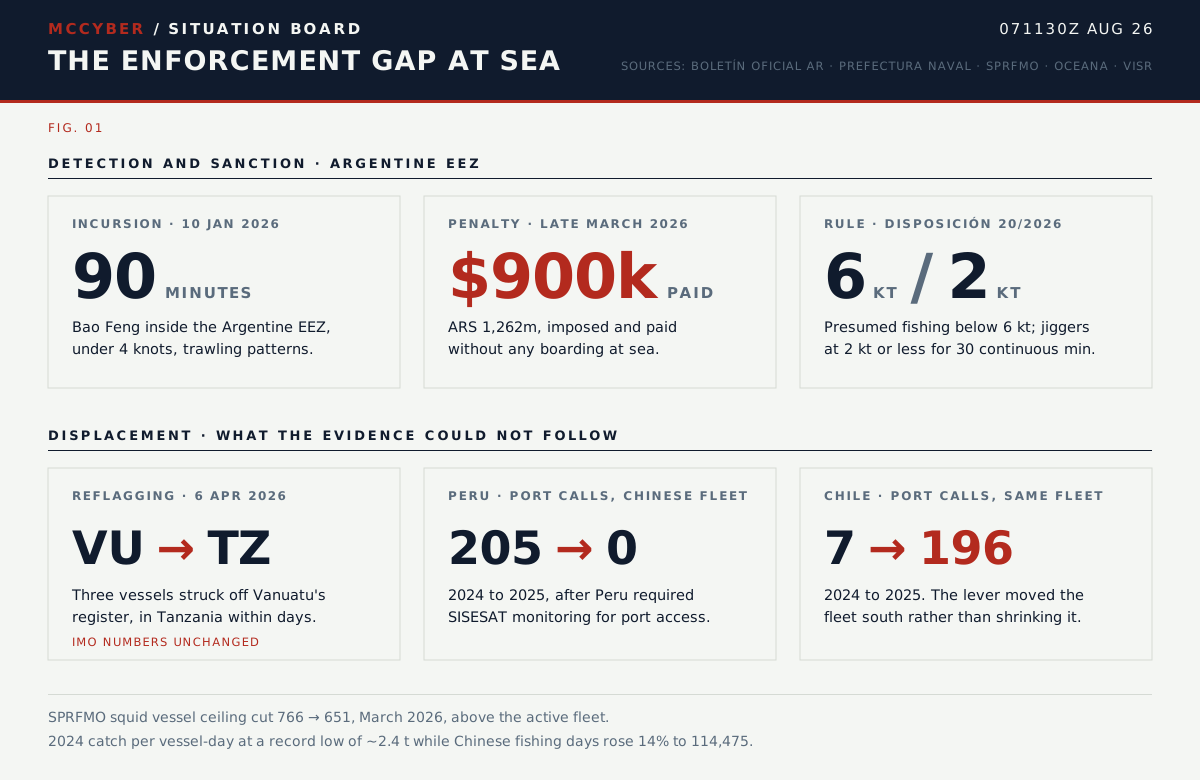
On the afternoon of 10 January 2026 a fishing vessel called the Bao Feng crossed into the Argentine exclusive economic zone off the coast of Chubut. It stayed for roughly an hour and a half, travelling at under four knots in patterns the Prefectura Naval described as consistent with trawling. It flew the flag of Vanuatu. It was built in China in 2025, and Chinese-owned.
No patrol boat reached it. No inspector went aboard. No net was seen.
In late March, after further incursions, Argentina fined it 1,262 million pesos, roughly 900,000 US dollars, and collected. Two more vessels, the Hai Xing 2 and the Bao Win, were penalised on the same basis, having been logged holding average speeds near 4.3 knots inside Argentine waters.
The case was built from the ships’ electronic tracks. The Prefectura’s Sistema Guardacostas, which fuses vessel-position feeds into a single traffic picture, made the detection; the data were then validated against Skylight, a satellite monitoring platform built for fisheries enforcement.
It anticipated a rule Argentina formalised three weeks later. Disposición 20/2026, published on 4 February, creates an explicit evidential presumption: a foreign fishing vessel inside the Argentine EEZ travelling below six knots while making course changes consistent with fishing manoeuvres is deemed, as a matter of law, to be fishing. Article 2 sets a tighter test for squid jiggers, at two knots or less for a continuous period of at least thirty minutes, absent justification. Refusal to be boarded counts against the ship. The master must rebut the inference with logs, weather records or technical evidence.
Then Vanuatu acted. On 6 April its international shipping registry confirmed it was deleting all three vessels from its register, saying ships creating repeated regulatory and reputational risk should not carry its flag.
Within days, tracking data showed the three under Tanzanian registration, still working. Their IMO numbers, the one identifier a ship carries for life, were unchanged. Their flags and radio identities were new.
The vessels Argentina fined belong to a wider pattern, often described as one fleet when it is two.
On both sides of South America the same geometry appears. In the Pacific, hundreds of squid jiggers work the high seas outside the exclusive economic zones of Ecuador, Peru and Chile. In the South Atlantic, another large distant-water fleet assembles along Argentina’s mile-200 boundary during the Illex season. Global Fishing Watch has tracked both operating simultaneously in different ocean basins, with vessels moving between grounds across the year rather than processing around the continent in a single column.
The Pacific side is the larger story. China’s own annual report to the South Pacific Regional Fisheries Management Organisation records 522 Chinese squid jiggers operating in the convention area in 2023, out of roughly 528 in total. NOAA puts China at more than 57 per cent of authorised squid jiggers there.
Coastal states control fishing within 200 nautical miles of their shores. Beyond that lies the high seas, where jumbo flying squid remain subject to no catch limit at all in SPRFMO waters. The squid migrate across the boundary, indifferent to it. Peru can cap its own fishermen and does. It has no authority over a vessel holding station at mile 201.
The numbers now point in an uncomfortable direction. South-east Pacific catches of the species hit a record 1.2 million tonnes in 2023, then fell to around 601,000 tonnes in 2024. The SPRFMO secretariat’s own dataset shows catch per vessel-day collapsing to a record low of about 2.4 tonnes in 2024, which China’s annual report attributes to El Niño warm-water anomalies. Over the same year, Chinese fishing days rose 14 per cent to 114,475. Effort went up as returns went down, which can reflect ocean conditions, fishing pressure or, most plausibly, some combination of the two. The science does not yet allow a confident attribution, because the scientific committee has still not completed a stock assessment framework for the species.
When the commission met in Panama City in March, it cut the ceiling on squid vessels from 766 to 651 and trimmed the fleet’s combined tonnage, a reduction of about fifteen per cent led by the United States. The active fleet is already smaller than the new limit. Members agreed to revisit the question in 2027. A Peruvian proposal for a buffer zone outside South American waters, the one measure that would have bitten immediately, was not adopted.
Subscribe
New essays and snapshots, by email, roughly weekly.
Persistent monitoring of large industrial vessels has become dramatically cheaper and easier, which has made this one of the world’s most visible distant-water fishing operations. When roughly three hundred Chinese vessels massed at the edge of the Galápagos reserve in 2020, Oceana used Global Fishing Watch data to log more than 73,000 hours of apparent fishing in a single month, 99 per cent of it by Chinese-flagged ships. Going dark no longer reliably makes a ship disappear either: HawkEye 360 used radio-frequency emissions to locate vessels during tracking gaps, and found Chinese-flagged ships accounted for 87 per cent of the gaps it identified.
None of that amounts to solving surveillance. Transponders can still be disabled or spoofed, revisit rates vary, small vessels remain hard to see, ownership stays opaque, and inferring what a ship is doing from its track is exactly that, an inference.
What changed in Argentina is that the inference became actionable. A behavioural reading of telemetry now supports a fine large enough to matter, with no boarding, no seizure and no risk to a crew in the South Atlantic in winter. That is a genuine advance, and the Bao Feng case proves it works.
It also shows what it does not reach. The evidence was admissible in Argentina and had no purchase anywhere else. A flag state withdrew its protection, which is rarer than it sounds and deserves credit. The response took days: a new registry, a new radio identity, the same hull back on the line. The owner is reported to be Hai Shun Shipping Co, a structure traced through offshore records to a Samoa-domiciled investment vehicle, which is the sort of arrangement designed to make exactly this manoeuvre cheap.
The bottleneck has moved. It sits in whether evidence can follow a vessel across flags, jurisdictions and ports.
There is a second approach running in parallel on the Pacific coast, and it is instructive because it worked without catching anybody at sea.
Late in 2024 Peru tightened the conditions for foreign fishing vessels seeking access to its ports, requiring them to use or integrate with SISESAT, the national satellite monitoring system, before coming in for fuel, repairs, supplies or crew changes. Oceana’s fisheries director in Chile has described the practical effect as a demand for six months of vessel monitoring history up front. This was a rule about paperwork attached to a physical chokepoint.
The effect was immediate. Peruvian ports received 155 Chinese vessels in 2023 and 205 in 2024. In 2025 they received none at all.
The fleet did not shrink. It went south. Chilean ports recorded seven calls by the distant-water squid fleet in 2024 and closed 2025 with 196, concentrated in Iquique and Talcahuano. Chile’s fisheries service, Sernapesca, reported entry requests rising from eight in 2024 to 130 within months, and said inspections had so far found no breaches.
Peru’s measure succeeded on its own terms: vessels unwilling to accept its conditions stopped using its ports. What failed was any attempt to impose that cost region-wide. The effect is partly displaced unless neighbouring harbours apply comparable conditions.
The same enforcement gap applies to what happens to the people aboard as much as to what the ships catch. The Environmental Justice Foundation interviewed 81 fishers, mostly Indonesian, who worked on 60 Chinese squid vessels between 2021 and 2025, and documented widespread fisheries and labour abuses. SPRFMO adopted binding minimum crew standards in March in response. Ships that stay at sea for months, resupplied by carriers and rarely inspected, are hard places to protect anyone.
Several counter-arguments deserve stating properly.
China’s high-seas squid fishery is largely lawful, reported and conducted inside a regional framework its government participates in. It acceded to the FAO port state measures agreement in March 2025, in force for China from 16 April, and accepted the SPRFMO effort reduction by consensus in March 2026. On the figures reported to SPRFMO, Peru’s own domestic fleet took a larger share of the record 2023 catch inside its EEZ than China’s fleet took on the high seas, which makes “China is emptying our ocean” an incomplete account of pressure on the stock.
Argentina’s protocol has serious critics at home, too. Argentine legal commentators argue that the presumptions sit awkwardly with the freedom of navigation the Law of the Sea preserves inside an exclusive economic zone, since a slow-moving foreign ship has not necessarily been fishing. Shifting the burden onto a master on the basis of a speed reading is efficient. It is also a tool any state could point at any foreign vessel it found inconvenient, and worth watching on those grounds rather than only on these.
There is one more inconvenient detail. Tanzania, where the three ships now sit, became a party to the same port state measures agreement in 2025. Joining the treaty and hosting the registry are evidently compatible.
Strip away the flag and the fine and this is a story about the distance between knowing and acting, and about how that distance is closing unevenly.
Argentina made digital evidence legally actionable. Peru made access to physical infrastructure conditional. Both worked. Both then met the next layer of the problem: reflagging in the first case, port displacement in the second. Neither failure was technological.
The measures that alter behaviour share one feature. They attach to something the fleet needs and cannot instantly substitute. A harbour. A fuel line. A crew change. The measures that struggle are the ones that depend on a ship caring about a flag it can discard in a week, or on evidence that stops at a national boundary.
Which leaves a question for anyone designing enforcement around better sensing, at sea or anywhere else. If detection keeps getting cheaper while jurisdiction stays fragmented, what exactly are the satellites buying us? In Argentina’s case the answer was 900,000 dollars and a deregistration. That is more than nothing. It is also less than a boundary.
Sources: Boletín Oficial de la República Argentina and the Subsecretaría de Recursos Acuáticos y Pesca, Prefectura Naval Argentina, SPRFMO Scientific Committee and Secretariat, FAO, NOAA Fisheries, Global Fishing Watch, Oceana, HawkEye 360, Environmental Justice Foundation, Vanuatu Daily Post, Infobae, Perfil, Mongabay, UPI, Diario Financiero, ArgenPorts, PortalPortuario.
Subscribe
McCyber intelligence briefings and structural essays, directly. No institutional spin.